
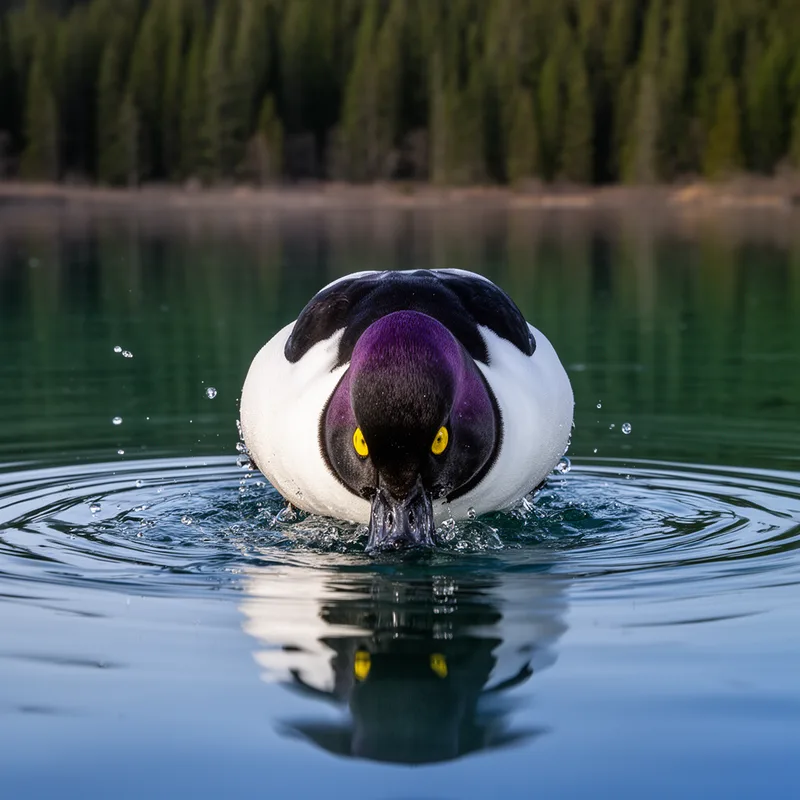
Bucephala islandica
- noun
- Specialized
- Unlike other ducks, Bucephala islandica prefers breeding in forested regions near cold, clear lakes.
Examples
-
The Bucephala islandica can often be seen diving for food in northern lakes.
-
The Bucephala islandica is known for its striking black-and-white plumage and bright yellow eyes.
-
Birdwatchers traveled to the lake hoping to catch a glimpse of Bucephala islandica during migration season.
-
The Bucephala islandica is known for its striking appearance.
-
Have you ever seen a Bucephala islandica up close?
-
Birdwatchers traveled to the lake hoping to catch a glimpse of Bucephala islandica during migration season.
-
Unlike other ducks, Bucephala islandica prefers breeding in forested regions near cold, clear lakes.
Synonyms

A North American diving duck with a white patch on its face and bright yellow eyes
Surface Forms
Morphology
Bucephala + islandica
This is a Linnaean binomial (genus + specific epithet): a learner who knows 'Bucephala' as a genus of ducks can infer the phrase refers to a species of that duck. However, 'islandica' is a Latinized epithet whose precise sense ('from Iceland' or 'island-related') depends on knowledge of Latin/taxonomic naming conventions, so the referent is only partly predictable without domain knowledge.
Etymology
Bucephala islandica comes from old words. The part Bucephala means 'ox-headed', a way to say the duck has a thick, rounded head, and islandica means 'from Iceland', so the name helps you picture a chunky-headed diving duck tied to Iceland.

