
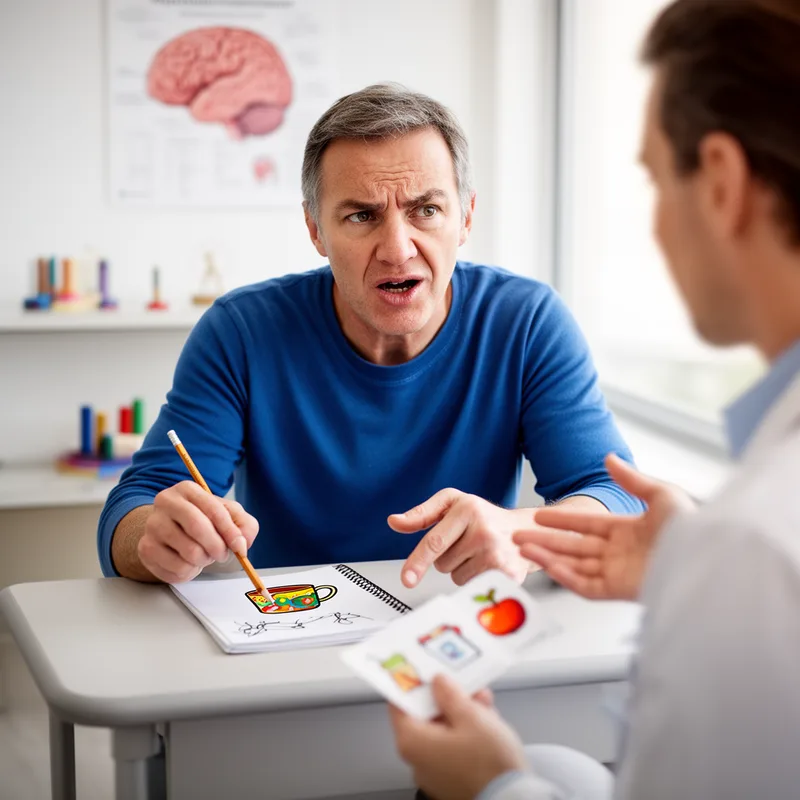
Broca's aphasia


 1
7.5
1
7.5
- noun
- /ˈbroʊkəz əˈfeɪziə/
- Specialized
- While her understanding was good, her Broca's aphasia prevented her from speaking fluently.
Examples
-
Therapists use specific exercises to help those with Broca's aphasia improve their communication skills.
-
Patients with Broca's aphasia struggle to form complete sentences.
-
After the stroke, the patient was diagnosed with Broca's aphasia, making it difficult for him to form sentences.
-
Is Broca's aphasia common after a stroke?
-
After his stroke, Mark was diagnosed with Broca's aphasia, making it difficult for him to speak clearly.
-
People with Broca's aphasia often understand language but struggle to construct sentences.
-
Therapy for Broca's aphasia can help individuals improve their speech abilities over time.
Synonyms
 10
9.1
10
9.1
A condition where a person cannot speak or understand words after brain damage
 1
7.7
1
7.7
A problem where a person has trouble speaking or writing but can still understand others
 1
9.9
1
9.9
A condition in which a person cannot speak but can still understand language
A condition after a stroke that makes speaking and writing very hard while understanding often stays good

A problem where a person cannot easily say or write words but can understand others
A condition in which a person cannot form clear sentences after brain injury
Surface Forms
Morphology
Broca's + aphasia
Knowing 'aphasia' lets a learner infer this is a kind of language disorder, so the general category is transparent. However, 'Broca's' is an eponym and does not signal the specific clinical profile (severe expressive impairment with relatively preserved comprehension), so the precise meaning is not predictable without specialist or prior exposure.
Etymology
Broca's aphasia is named after the doctor Paul Broca, who studied people with damage to a part of the brain and noticed they could not speak — one famous patient could only say the sound 'tan'. That's why the name refers to a condition where a person can 'understand' language but cannot 'speak'.