

expressive aphasia


 1
7.7
1
7.7
- noun
- /ɪkˈsprɛsɪv əˈfeɪʒə/
- Specialized
- The therapist worked with her to improve her communication skills despite her expressive aphasia.
Examples
-
After his stroke, he developed expressive aphasia, making it difficult for him to find the right words.
-
Patients with expressive aphasia often understand others well but struggle to convey their own thoughts verbally.
-
Of these, 10 were eliminated from the study by facility staff because of cognitive impairment or communication problems such as expressive aphasia.
Academic text (2002) -
Findings on neurologic examination were within normal limits except for mild nuchal rigidity and some mild expressive aphasia.
Academic text (2002) -
Stroke survivors with receptive or expressive aphasia, or left hemispheric stroke, were not included because the study inclusion criterion required adequate verbal communication skills.
Academic text (2010)
Synonyms
 10
9.1
10
9.1
A condition where a person cannot speak or understand words after brain damage
 1
7.5
1
7.5
A condition in which a person understands others but cannot speak or write well
 1
9.9
1
9.9
A condition in which a person cannot speak but can still understand language
 1
8.7
1
8.7
Not being able to speak or write clearly

A problem where a person cannot easily say or write words but can understand others
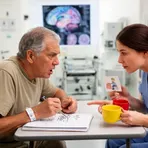
A condition after a stroke that makes speaking and writing very hard while understanding often stays good
How Expressive

Surface Forms
Morphology
The phrase combines 'expressive' (relating to expressing thoughts) with 'aphasia' (a language impairment), so it straightforwardly denotes a type of aphasia that primarily affects expression rather than comprehension. This modifier+condition composition is a regular, predictable pattern in medical terminology and would be understandable to a B1 learner who knows both constituents.
Etymology
Expressive aphasia combines expressive, about showing or saying, and aphasia, a loss of words, to paint the image of someone who understands others but cannot 'express' their own words. That's why it means having trouble speaking or writing even though you can still understand speech.