
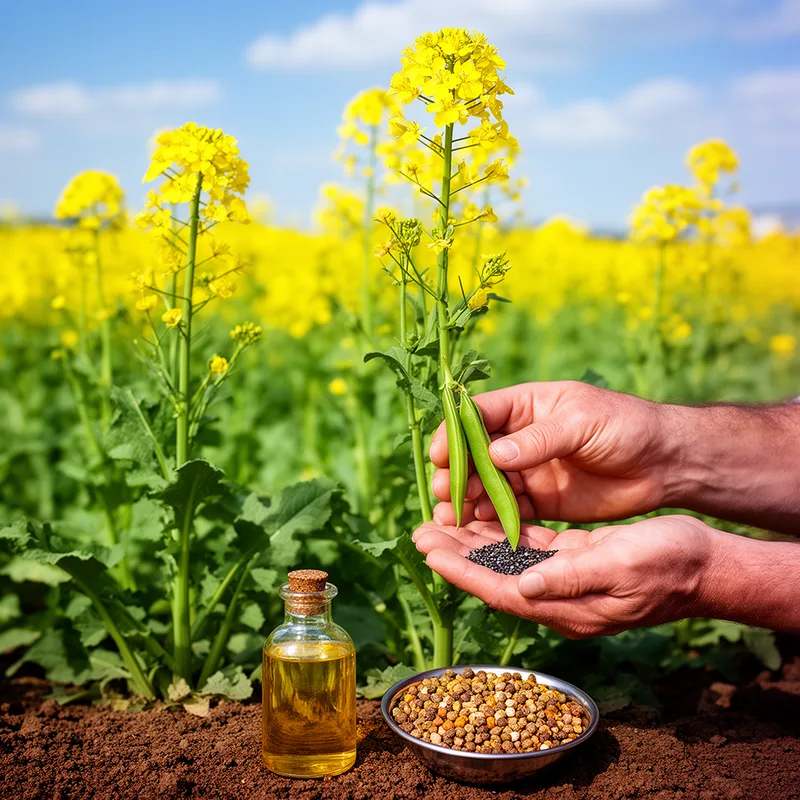
Brassica napus
- noun
- Specialized
- Farmers often grow Brassica napus for its oil-rich seeds.
Examples
-
Extensive fields of Brassica napus bloom with bright yellow flowers in the spring.
-
Farmers rotate wheat with Brassica napus to improve soil health.
-
Brassica napus is commonly grown for the production of canola oil.
-
The Brassica napus plant thrives in cooler climates.
-
Brassica napus is a crucial crop for producing rapeseed oil used in cooking.
-
Many farmers cultivate Brassica napus as a forage crop to feed livestock.
-
In spring, fields of Brassica napus are filled with vibrant yellow flowers.
Synonyms

 4
8.6
4
8.6

A plant with yellow flowers grown for oil from its seeds
 1
4.4
1
4.4
A plant with seeds that make oil used for cooking and food for animals

A plant with bright yellow flowers grown for seeds that make oil and sometimes fed to animals
Surface Forms
Morphology
Brassica + napus
This is a Latin binomial: knowing 'Brassica' (a genus including cabbages and broccoli) lets a learner infer it is a kind of plant, but the specific species sense 'napus' (rapeseed) is not a normal English word and gives no obvious clue. Binomial species names and the agricultural meaning (oilseed/forage crop) are specialized knowledge, so the overall meaning is partially but not fully derivable from the parts.
Etymology
Brassica napus comes from old Latin words for common vegetables: Brassica meant cabbage and similar plants, and napus meant 'turnip'. This name gives a simple picture—it's a plant in the cabbage/turnip family grown for seeds used to make oil and for animal feed.