
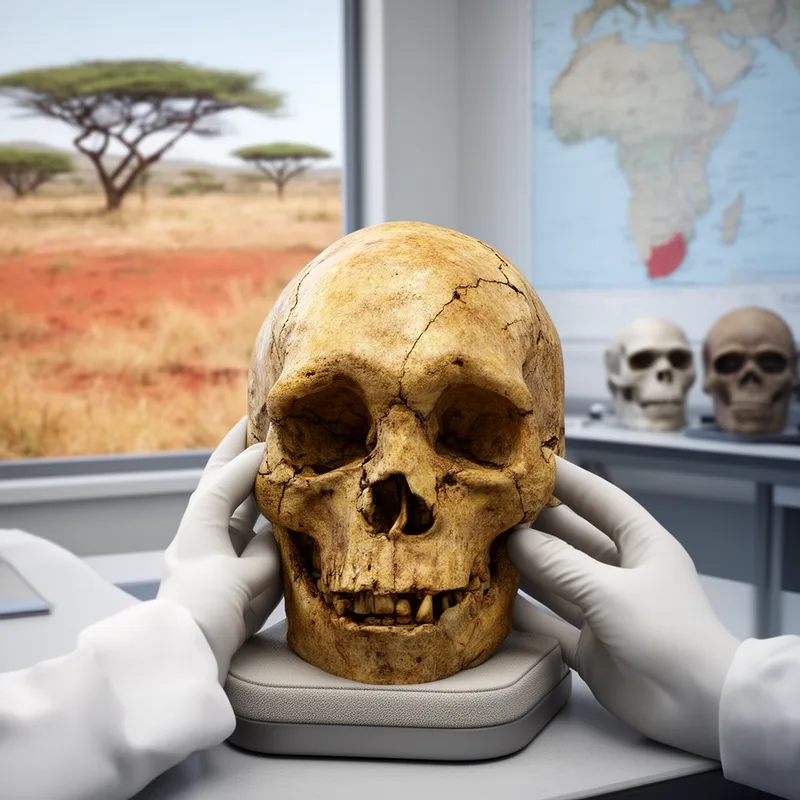
Boskop man
- noun
- /ˈbɑːskɒp mæn/
- Archaic
 :
hombre Boskop
:
hombre Boskop
- Some scientists now believe that Boskop man belonged to early Homo sapiens, not a separate species.
Examples
-
The discovery of the Boskop man skull led to early theories about human evolution in Africa.
-
The Boskop man fossils were initially thought to show a unique human lineage.
-
The Boskop man is believed to have lived over 10,000 years ago.
-
Many scientists study the Boskop men to understand human evolution.
-
Some scientists now believe that Boskop man belonged to early Homo sapiens, not a separate species.
-
The discovery of the Boskop man skull led to early theories about human evolution in Africa.
-
The Boskop man fossils were initially thought to show a unique human lineage.
Surface Forms
Morphology
Boskop + man
The phrase pairs the unknown proper name 'Boskop' with 'man', so a learner who knows 'man' can infer it refers to a person or human group associated with Boskop. However, because 'Boskop' is an unfamiliar toponym and the term denotes a specific paleontological classification (an early Homo sapiens/cranium), the precise technical meaning is not derivable from the parts alone.
Etymology
Boskop man comes from the name of a place, Boskop, in South Africa where a large old skull was found and studied, and the fossil was called the Boskop man. So today the name refers to that early human skull or a possible early 'Homo sapiens'.

