
Boselaphus tragocamelus
- noun
- Specialized
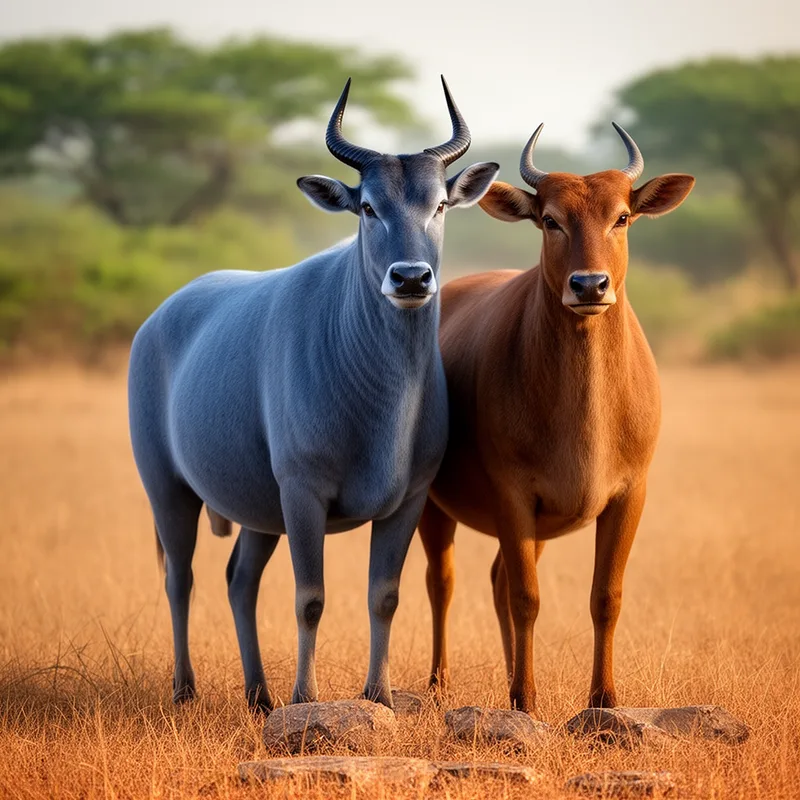
- A male Boselaphus tragocamelus is easily recognized by its striking blue-grey coat with white markings.
Examples
-
The Boselaphus tragocamelus is one of the largest antelopes found in India.
-
The Boselaphus tragocamelus is known for its distinctive blue-grey coat.
-
A male Boselaphus tragocamelus stands out due to its distinctive blue-grey coloration.
-
Zookeepers carefully monitored the health of their Boselaphus tragocamelus population.
-
Did you see the Boselaphus tragocamelus at the zoo?
-
The Boselaphus tragocamelus is often seen grazing in the grasslands of northern India.
-
Conservation efforts are important to protect the Boselaphus tragocamelus and its habitat.
Synonyms

 1
9.9
1
9.9

A large antelope from India with blue-grey males and brown hornless females

A large deer-like animal from India whose male has a blue-grey coat and whose female is brown and hornless
A large antelope from India whose males are blue-grey with horns and females are brown without horns
Surface Forms
Morphology
Boselaphus + tragocamelus
This is a Latin binomial (scientific) name: the parts are taxonomic/proper-name elements rather than everyday English words, and one constituent ('tragocamelus') is not a recognized dictionary word. A B1 learner who knows the constituents would not be able to derive the meaning or the common name/description (nilgai, a large antelope) from them, so the expression is not compositional or transparent.
Etymology
Boselaphus tragocamelus may come from old words, with Boselaphus giving the idea of 'ox' and 'deer' and tragocamelus giving the idea of 'goat' and 'camel', creating a picture of a big, odd deer-like animal. So the name points to the 'nilgai' or 'blue cow'—a large Indian antelope with blue-grey males and brown females—making it easier to remember that this is a large, unusual antelope.