
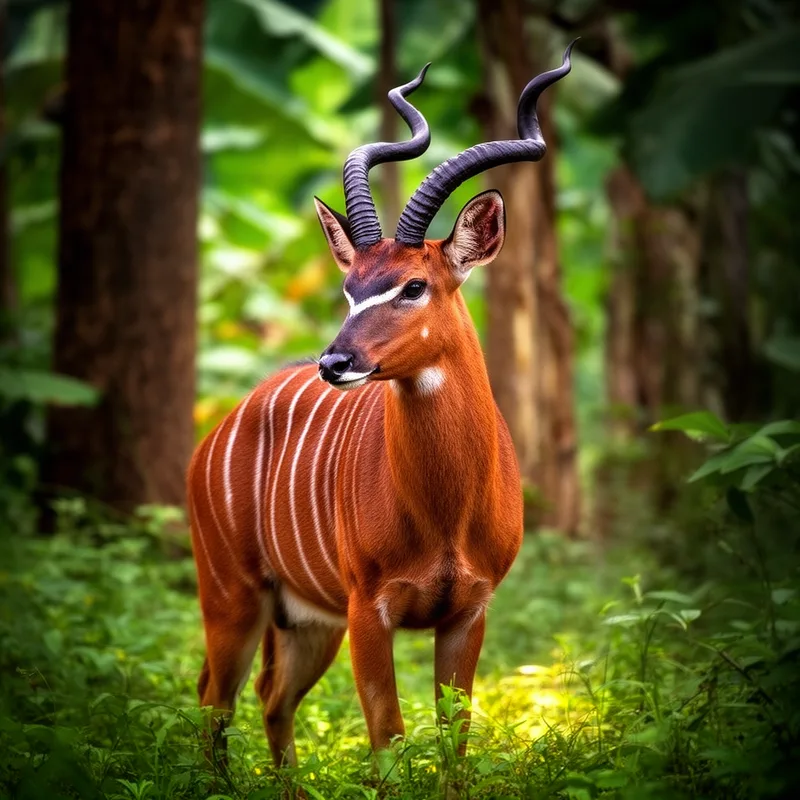
Boocercus eurycerus
- noun
- Specialized
- The Boocercus eurycerus is known for its striking white stripes and spiral horns.
Examples
-
The Boocercus eurycerus roams the lush forests of central Africa, showcasing its reddish-brown coat and unique white stripes.
-
Wildlife photographers travel to central Africa to capture images of the elusive Boocercus eurycerus.
-
Conservation efforts are underway to protect the habitat of the Boocercus eurycerus from deforestation.
-
The Boocercus eurycerus is known for its striking appearance.
-
Have you ever seen a Boocercus eurycerus in the wild?
-
Visitors to national parks in central Africa are often excited to spot the Boocercus eurycerus grazing peacefully among the trees.
-
Efforts to conserve the Boocercus eurycerus have increased due to its vulnerable status in the wild.
Synonyms


 1
9.6
1
9.6
A large forest antelope from central Africa with reddish-brown fur and white stripes

A large reddish-brown forest antelope with white stripes and long twisted horns from Central Africa
Surface Forms
Morphology
Boocercus + eurycerus
The item is a Latin binomial taxonomic name whose constituent elements are not recognisable English words in the learners' lexicon, so the meaning 'large forest antelope (bongo)' cannot be derived from the parts. While specialists might infer something from classical roots, an average B1 learner who knows the shown constituents would not be able to predict the animal meaning, making it fully non-compositional for that learner level.
Etymology
Boocercus eurycerus, made of Boocercus and eurycerus, may come from old words meaning 'ox' and 'long horn', which gives a picture of a large, horned animal in the forest. That's why the name fits the animal we now call the 'bongo'.