

Boccaccio
 1
9.7

- proper noun
- /boʊˈkɑːtʃoʊ/
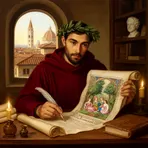
- Giovanni Boccaccio is celebrated for his seminal work, 'The Decameron'.
- Boccaccio's Decameron
- Giovanni Boccaccio
Examples
-
One of Petrarch's most important disciples was the Florentine author and scholar Giovanni Boccaccio.
Academic text (2009) -
I wrote, for instance, "Shakespeare, Boccaccio, and many others frequently portrayed fictional women disguising themselves as men."
Fiction book (1995) -
His friend Boccaccio said of Giotto that he brought back the light.
-
Like Cavalcanti, Boccaccio too did not attack the enemies of his state.
Academic text (2018) -
The way in which Boccaccio uses a narrative frame in the Filostrato has been little explored.
Fiction book (1991) -
The Renaissance humanist Giovanni Boccaccio describes the indiscriminate and pervasive devastation of the bubonic plague.
Academic text (2010) -
Indeed, throughout her poems, Eliot linked herself to a great poetic tradition by invoking Dante, Boccaccio, Homer, Erinna, Sappho, and Shakespeare.
Academic text (2016) -
A 15th-century French manuscript of The Fall of Princes by Giovanni Boccaccio (1313–75), illustrating feminine vanities.
Academic text (2011) -
In Italian literature, Boccaccio is known as a pioneering figure of the Renaissance period.
-
The influence of Boccaccio can be seen in many later writers who adopted his narrative techniques.
Synonyms

 1
9.3
An Italian writer and poet of the 1300s famous for The Decameron
Surface Forms
Etymology
Boccaccio is an Italian family name that probably began from the Italian word bocca 'mouth'. A helpful way to remember it is to think of a nickname for a 'talker' or someone with a 'big mouth', and that nickname later became the family name of the famous writer Giovanni Boccaccio.