
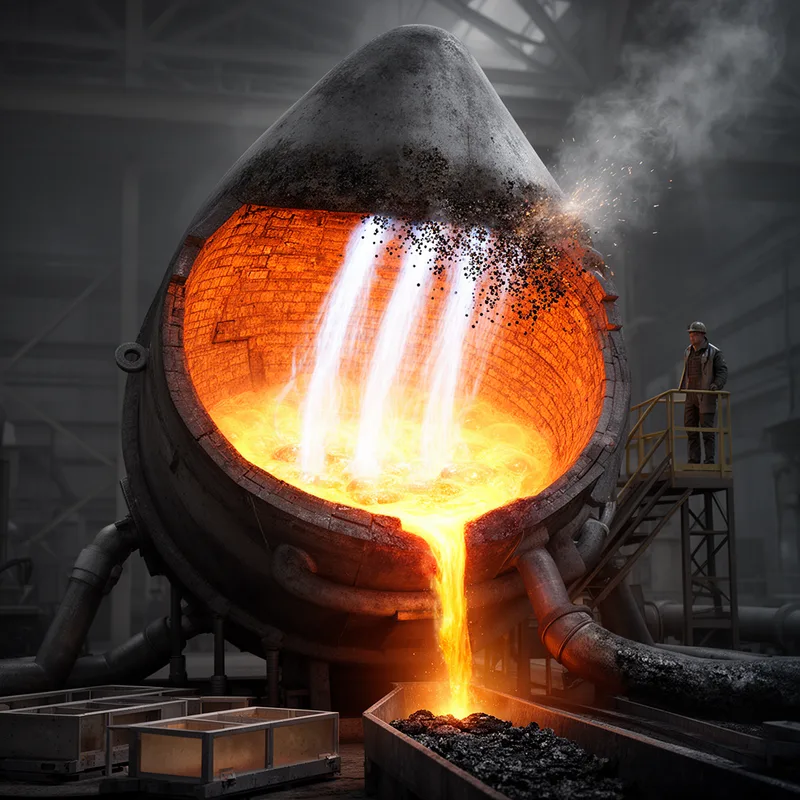
Bessemer process


 1
6.5
1
6.5
- noun
- /ˈbɛsəmər ˈprɑːsɛs/
- Archaic
- Many old factories still display equipment once used for the Bessemer process.
Examples
-
Many factories adopted the Bessemer process to increase efficiency.
-
The Bessemer process revolutionized steel production in the 19th century.
-
Because of the Bessemer process, steel became much more affordable and widely used in construction.
-
The invention of the Bessemer process revolutionized steel production in the nineteenth century.
-
The Bessemer process revolutionized steel production by allowing large quantities of purified metal to be created efficiently.
-
By implementing the Bessemer process, manufacturers significantly reduced the cost of producing high-quality steel.
-
The introduction of the Bessemer process enabled factories to produce steel at a pace that met the growing demands of the industrial revolution.
Surface Forms
Morphology
The phrase is compositionally transparent in that a learner can infer it denotes a process associated with someone named Bessemer, but that only yields a very general notion (a process by Bessemer) and not the specific technical meaning (a steelmaking method involving blowing air through molten iron). Because the specific semantic content is specialized and requires historical/technical knowledge beyond the constituent words, it is only partially predictable.
Etymology
Bessemer process is named after the inventor Henry Bessemer, who found that blowing air through hot, melted iron could burn away unwanted bits like carbon. That's why the name now means 'a way to make a lot of steel cheaply'.