

Berlin airlift
 1
5.5
1
5.5

- noun
- /bɜrˈlɪn ˈɛrˌlɪft/
- Reminiscent of the Berlin airlift, a steady stream of adult albatrosses landed and took off in a tireless effort to keep their six-month-old chicks fed.
- the Berlin airlift of 1948
Examples
-
During the Berlin airlift, planes flew over West Berlin delivering essential supplies to the city's residents.
-
Even before the 1948 election, he had launched the Marshall Plan, embraced the United Nations, and commenced the Berlin airlift, making clear America's commitment to Western Europe's security and to a continuing global role.
Academic text (1992) -
The swordplay of the Soviet Union and the United States rightfully claims attention because it led to the Korean and Vietnam wars, as well as the Berlin airlift, Cuban missile crisis, American intervention in many parts of the world, a huge investment in scientific research, and environmental damage that will take generations to rectify.
Academic text (1996) -
The Berlin airlift was a crucial response by the Western Allies to the Soviet blockade of the city in 1948.
-
In 1948, the Berlin airlift demonstrated the commitment of Western nations to support West Berlin during a time of crisis.
Synonyms
 21
4.7
21
4.7
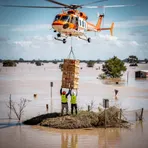
Moving people or supplies by plane when other transport is not possible
Surface Forms
Morphology
This is a straightforward place-name + noun composition: a B1 learner who knows 'Berlin' and 'airlift' (moving supplies by aircraft) can infer it refers to an airlift operation involving Berlin. The meaning is fully compositional and follows standard English noun-modifier patterns, so it is immediately understandable from the parts.
Etymology
Berlin airlift names a real event in 1948-49 when Soviet forces blocked roads to West Berlin. Western countries flew thousands of planes to carry food, fuel and medicine into the city, so the term connects Berlin with air delivery and now means 'to supply a place by air'.