

Ballota nigra
- noun
- Specialized
- Herbalists sometimes use Ballota nigra for traditional remedies despite its unpleasant odor.
Examples
-
The dark purple flowers of Ballota nigra attract pollinators in early summer.
-
In Europe, Ballota nigra is often found in rocky areas and is known for its wrinkled leaves.
-
The garden had several Ballota nigra plants growing near the wall.
-
The Ballota nigra plant is often used in herbal remedies.
-
Have you ever seen Ballota nigra growing in the wild?
-
The dark purple flowers of Ballota nigra add interesting color to the garden.
-
Herbalists sometimes recommend Ballota nigra for its medicinal properties due to its distinct aroma.
Synonyms
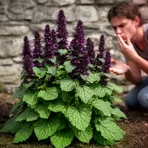
A European herb with wrinkled leaves and dark purple flowers that smell bad

A European herb with wrinkled leaves that smells very bad

A small herb with wrinkled leaves, dark purple flowers and a strong unpleasant smell

A plant with wrinkled leaves and dark purple flowers that has a strong unpleasant smell
Surface Forms
Morphology
Ballota + nigra
This is a Latin binomial combining a genus name (Ballota) with a species epithet (nigra, Latin for 'black'); if a learner knows both constituents they can infer it refers to the ‘black’ species of the Ballota herb (i.e., black horehound). However, as a technical, Latin scientific name functioning as a proper noun rather than a normal English compositional phrase, the relationship is not fully transparent to typical learners, so the transparency is only partial.
Etymology
Ballota nigra is a scientific name that pairs the herb group Ballota with the Latin word nigra, which means 'black', a nod to its dark purple flowers and wrinkled leaves. Because the plant also gives off a strong, unpleasant smell, the 'black' name helps people remember this dark, smelly herb today.

