
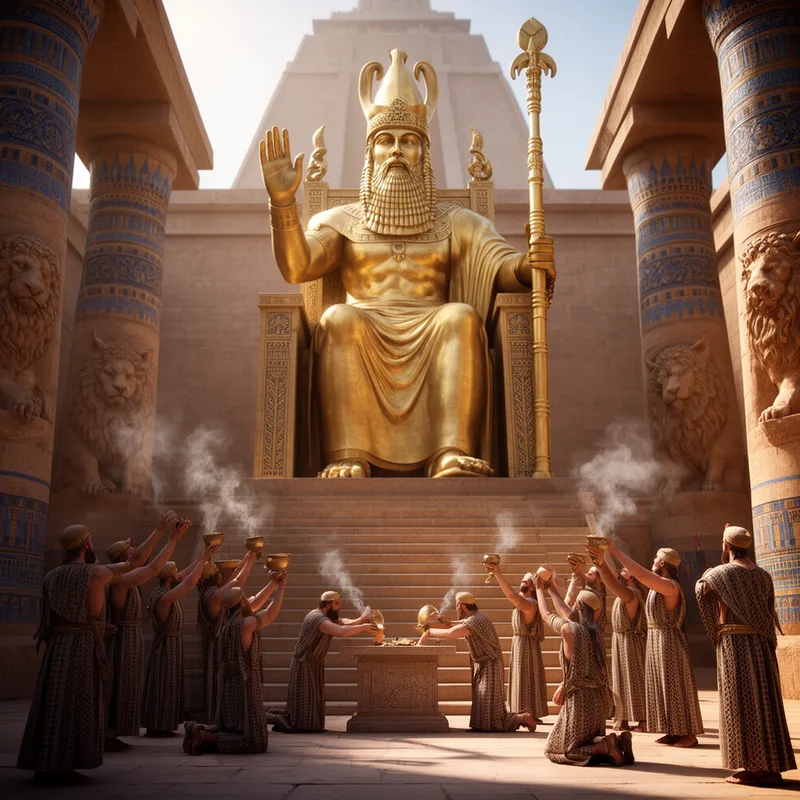
Baal Merodach
- proper noun
- Literature
- Priests in Babylon performed rituals in honor of Baal Merodach during the New Year festival.
Examples
-
The temple dedicated to Baal Merodach stood at the heart of the great city of Babylon.
-
In ancient Babylon, Baal Merodach was worshipped as the chief god.
-
Ancient texts frequently mention Baal Merodach as the supreme god worshipped in Babylon.
-
Many temples were dedicated to Baal Merodach throughout Mesopotamia.
-
Ancient texts frequently mention Baal Merodach as the supreme god worshipped in Babylon.
-
Priests in Babylon performed rituals in honor of Baal Merodach during the New Year festival.
-
In ancient Babylon, Baal Merodach was worshipped as the chief god.
Synonyms
 3
9.9

The main god of ancient Babylon whom people worship as the city's protector


 1
9.9
The main god worshipped in ancient Babylon, also called Marduk
The main god in ancient Babylon who people worship as the city's protector
Surface Forms
Morphology
The form is compositional: 'Baal' is a Semitic title meaning 'lord' or 'local deity' and 'Merodach' is the name of the principal Babylonian god, so together they denote the deity Merodach as lord/chief god. A B1 learner who knows both constituents can straightforwardly infer this referential meaning rather than an idiomatic one, so the expression is transparent.
Etymology
Baal Merodach comes from two words used by people in ancient Babylon: Baal meaning 'lord' and Merodach, the name of the city's chief god. People built a great temple and held big festivals for Baal Merodach, so the name came to mean the 'supreme god' of Babylon.