

Avicennia
- noun
- Specialized
- The leaves of Avicennia often excrete excess salt, a unique adaptation among mangroves.
Examples
-
The roots of Avicennia help stabilize coastal shorelines and provide habitats for marine life.
-
The Avicennia trees thrive in saline coastal environments.
-
Researchers studied how Avicennia species tolerate high salinity in estuarine environments.
-
Many species of Avicennia are important for coastal ecosystems.
-
The Avicennia trees thrive in muddy coastal areas where other plants cannot survive.
-
Researchers studied how Avicennia species tolerate high salinity in estuarine environments.
-
The roots of Avicennia help stabilize coastal shorelines and provide habitats for marine life.
Compounds

- Specialized
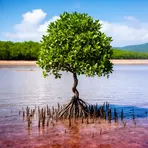
A mangrove tree that grows on coasts and has many short roots above the ground
- Specialized
A small to medium mangrove tree that grows in partly salty water along tropical coasts
Surface Forms
Etymology
Avicennia is the scientific name for a group of mangrove trees and comes from the name of the Persian doctor Avicenna (Ibn Sina), a famous writer on medicine. Plant scientists gave the trees his name to honor him, so thinking 'Avicenna's trees' helps you remember that Avicennia refers to these coastal mangroves.

