
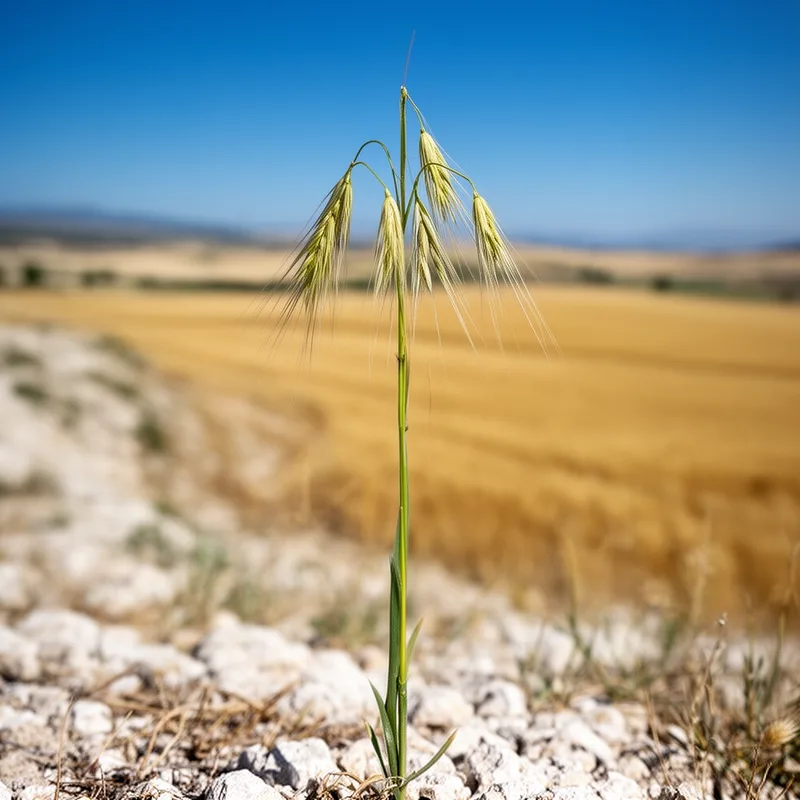
Avena sterilis
- noun
- Specialized
- Many botanists believe that Avena sterilis is the progenitor of the oats we grow today.
Examples
-
Researchers studied Avena sterilis to understand the genetic origins of domesticated oats.
-
The Avena sterilis is often found in Mediterranean regions.
-
In the wild, Avena sterilis thrives in the Mediterranean climate.
-
Farmers are interested in the genetic traits of Avena sterilis.
-
In arid regions, Avena sterilis is known for its adaptability to harsh Mediterranean conditions.
-
Many farmers study Avena sterilis to improve modern oat varieties through selective breeding.
-
Scientists have confirmed that Avena sterilis is the wild ancestor from which cultivated oats descend.
Synonyms

A wild Mediterranean grass that is the original form of the grain grown for food
A wild oat that grows in the Mediterranean and is an ancestor of the oats we grow
Surface Forms
Morphology
Avena + sterilis
The element 'Avena' clearly signals the oat genus, so a learner who knows that word would infer this is a kind of oat. However 'sterilis' is not a common English word (and scientific Latin epithets are labels rather than compositional descriptions), so the precise sense 'wild Mediterranean species believed to be the ancestor of cultivated oats' is not derivable from the parts, giving only partial predictability.
Etymology
Avena sterilis comes from Latin words: Avena means 'oat' and sterilis means 'barren' or 'not producing many seeds'. It is a wild Mediterranean oat thought to be the ancestor of the oats we grow today, so the name helps you remember it is the wild, earlier form of farmed oats.

