
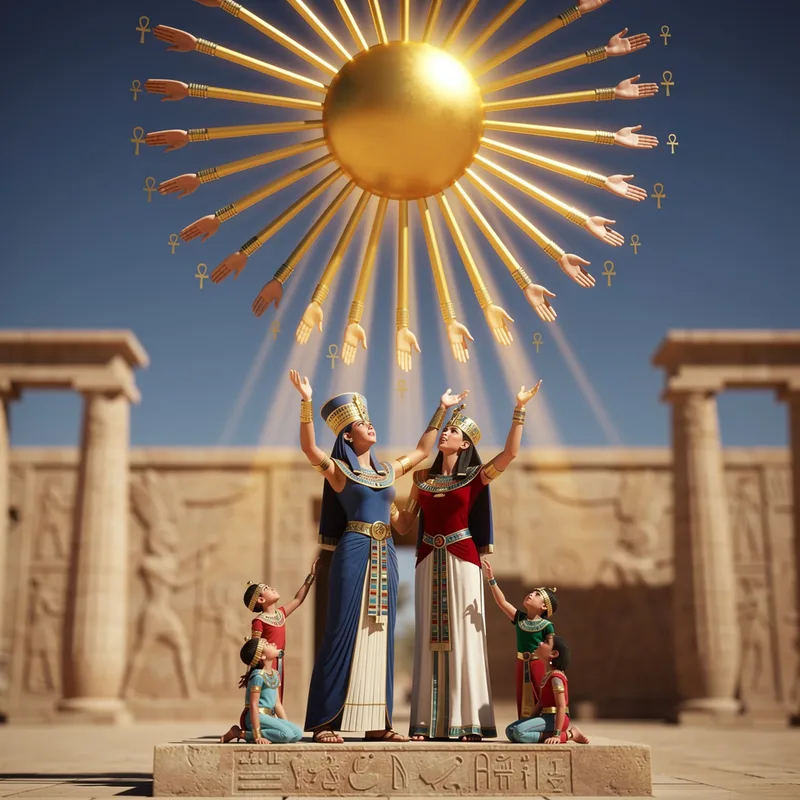
Aten
 2
9.9
2
9.9

- noun
- /ˈɑːtən/
- Literature
- A scribe buried in one has two names: Raya, typical of the Aten cult, and Hatyiay, a word related to the Theban god Amun.
- Aten, the sun
Loading YouTube…
Watch on YouTubeAnd there was an Egyptian pharaoh named Akhenaten who basically his name meant the worship of the Aten, which is the sun disk.
- And there was an Egyptian pharaoh named Akhenaten who basically his name meant the worship of the Aten, which is the sun disk.
Examples
-
And there was an Egyptian pharaoh named Akhenaten who basically his name meant the worship of the Aten, which is the sun disk.
-
Had he not earned a stipend and a prosperous farm from his work in Horizon of the Aten, he would have left royal service.
Fiction book (1998) -
And thus the sunset in the West and RA alongside Aten began his trip through the underworld.
-
Aten!
-
In that period, the capital was Thebes, and for a brief time in the fourteenth century B.C., it moved to Amarna when Akhenaten abandoned the old gods for his sun god, Aten.
Academic text (2006) -
It was clear that Tutankhamun had not simply added scenes to an existing structure of Akhenaten—who likely was his own father—but had actually taken down one of his buildings dedicated to the solar god Aten and reused the blocks!
Academic text (2010) -
Worship of Amun and Mut was suppressed by Akhenaten (1360-1343), the heretical pharaoh who promoted a cult of the sun or Aten.
Academic text (2006) -
The ancient Egyptians built temples to honor Aten, the sun god they worshipped as the sole deity.
-
Under Pharaoh Akhenaten, the worship of Aten became central to Egyptian religious practices.
-
During his reign, Akhenaten promoted Aten as the supreme god, symbolized by the solar disc.
Synonyms
 2
9.9
2
9.9
The sun god that Pharaoh Akhenaten made the only god in ancient Egypt
Surface Forms
Etymology
Aten comes from ancient Egyptian and means the sun 'disc', the round shape of the sun. Pharaoh Akhenaten made the Aten the one god for a short time, so Aten is the name used for that sun deity.