

Aster tripolium
- noun
- UK
- The Aster tripolium thrives in salty marshes along the European coasts.
Examples
-
She collected samples of Aster tripolium to study salt tolerance in flowering plants.
-
Ecologists noted that Aster tripolium is vital for supporting local insect populations.
-
The Aster tripolium thrives in coastal environments.
-
Many gardeners appreciate the beauty of Aster tripolium.
-
The Aster tripolium is often found flourishing in salt marshes along the coast of Europe.
-
Ecologists study Aster tripolium to understand its role in the coastal ecosystem.
-
Many conservationists work to protect Aster tripolium as it provides habitat for various insects.
Synonyms

A plant with pale purple flowers that grows in salt marshes by the sea
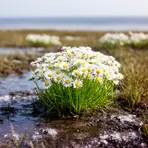
A common European plant like a daisy that grows in salt marshes
Surface Forms
Morphology
aster + tripolium
This is a Latin binomial combining the genus name 'Aster' with a specific epithet; a learner who knows 'aster' can transparently infer that 'Aster tripolium' refers to a kind of aster (i.e., a plant species). Although 'tripolium' has no independent English lexical meaning, in this construction it functions as a label for the species and the genus+epithet pattern is cross-linguistically familiar, so the overall meaning is derivable from the constituents.
Etymology
Aster tripolium is a plant name that paints a clear picture: aster means a little 'star' because the flower looks star-shaped, and tripolium was an old name used for plants that grow near the sea. So the name points to a small star-like flower living in salty marshes, which is why it refers to the sea aster.

