
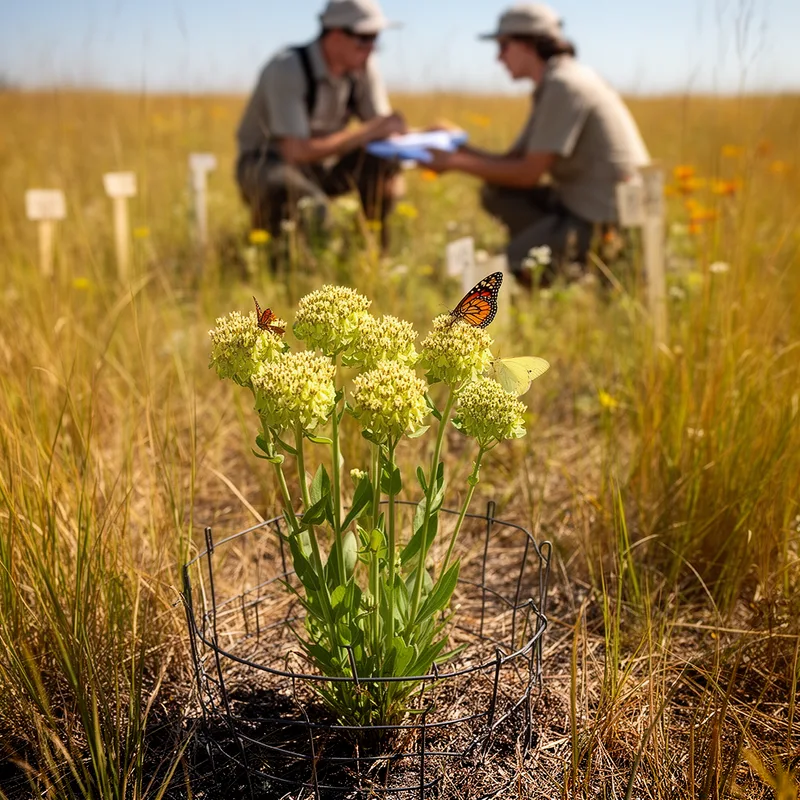
Asclepia meadii
- noun
- Specialized
- Efforts to reintroduce Asclepia meadii focus on preserving its natural grassland habitat.
Examples
-
The conservation of Asclepia meadii is critical for local butterfly populations.
-
Botanists have documented several new occurrences of Asclepia meadii in restored prairies.
-
The rare Asclepia meadii grows in specific habitats.
-
Have you seen any Asclepia meadii in the wild?
-
Efforts to reintroduce Asclepia meadii focus on preserving its natural grassland habitat.
-
The conservation of Asclepia meadii is critical for local butterfly populations.
-
Botanists have documented several new occurrences of Asclepia meadii in restored prairies.
Synonyms

 1
9.9
1
9.9

A rare flowering plant that lives many years in central North America and is now threatened
A rare milkweed plant from central North American prairies that is in danger because of habitat loss
Surface Forms
Morphology
Asclepia + meadii
This is a Latin scientific (binomial) name whose parts are not ordinary English words with compositional meanings; a B1 learner who 'knows' the constituent forms would not be able to infer that it denotes a species of milkweed. Taxonomic names function as arbitrary labels across languages rather than transparent compound phrases, so the meaning is not derivable from the parts.
Etymology
Asclepia meadii may come from two parts: Asclepia, from 'Asclepius', the Greek god of healing, and meadii, which honors a plant collector named Mead. Because milkweed was once used in old medicine, the name links the plant to healing and shows it belongs to Mead, so we call it 'Mead's milkweed' today.