
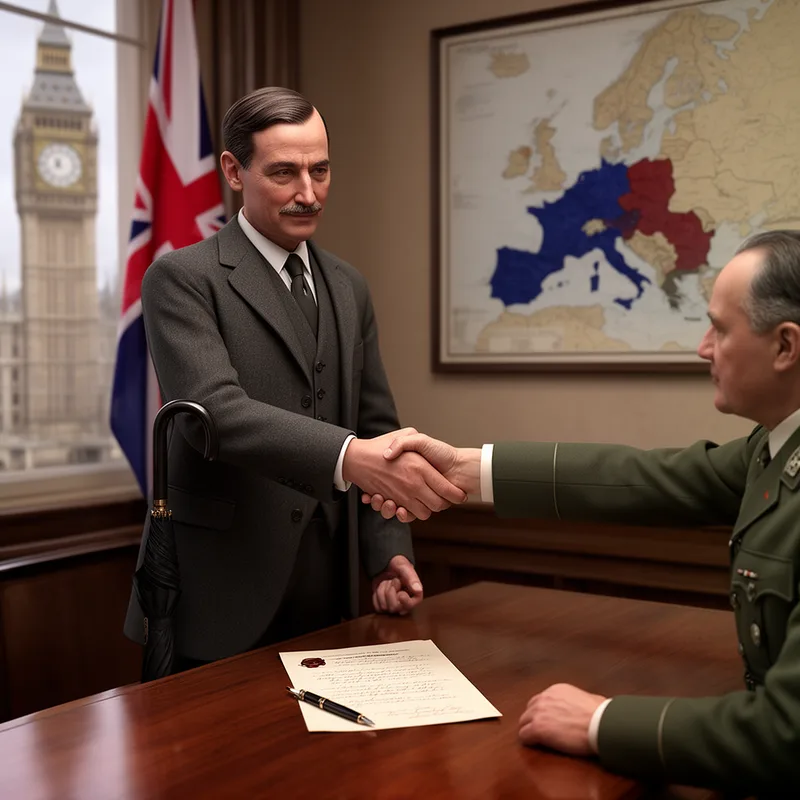
Arthur Neville Chamberlain


 1
8.3
- proper noun
- In 1938, Arthur Neville Chamberlain famously declared that he had achieved 'peace for our time' after meeting with Hitler.
Examples
-
Arthur Neville Chamberlain is often remembered for signing the Munich Agreement in 1938.
-
Many historians debate whether Arthur Neville Chamberlain's appeasement policy was justified at the time.
-
As Prime Minister, Arthur Neville Chamberlain aimed to maintain peace in Europe but faced criticism after World War II began.
-
Did Arthur Neville Chamberlain really think he could trust Hitler?
-
The legacy of Arthur Neville Chamberlain continues to be debated among historians.
-
Arthur Neville Chamberlain was Prime Minister of the United Kingdom from 1937 until 1940, during a critical period in European history.
-
Many people associate Arthur Neville Chamberlain with his controversial policy of appeasement toward Nazi Germany before the war.
Synonyms
 11
7.5
British Prime Minister before World War II who is known for trying to avoid war with Nazi Germany
 4
7.5
British prime minister from 1937 to 1940 who tried to avoid war with Germany
Surface Forms
Morphology
Arthur + Neville + Chamberlain
This is a proper name referring to a specific historical person; knowing the individual name parts ('Arthur', 'Neville', 'Chamberlain') does not let a learner infer that he was a British prime minister or that he pursued a policy of appeasement. Proper nouns and associated biographical or political facts require world/cultural knowledge rather than compositional lexical knowledge, so the MWE is not transparent to a B1 learner.
Etymology
Arthur Neville Chamberlain was the British prime minister who, in 1938, signed the Munich Agreement and returned home saying 'peace for our time'. Because he tried to avoid war by giving in to Hitler, his name is now linked to the idea of 'appeasement' and is remembered for that choice.