
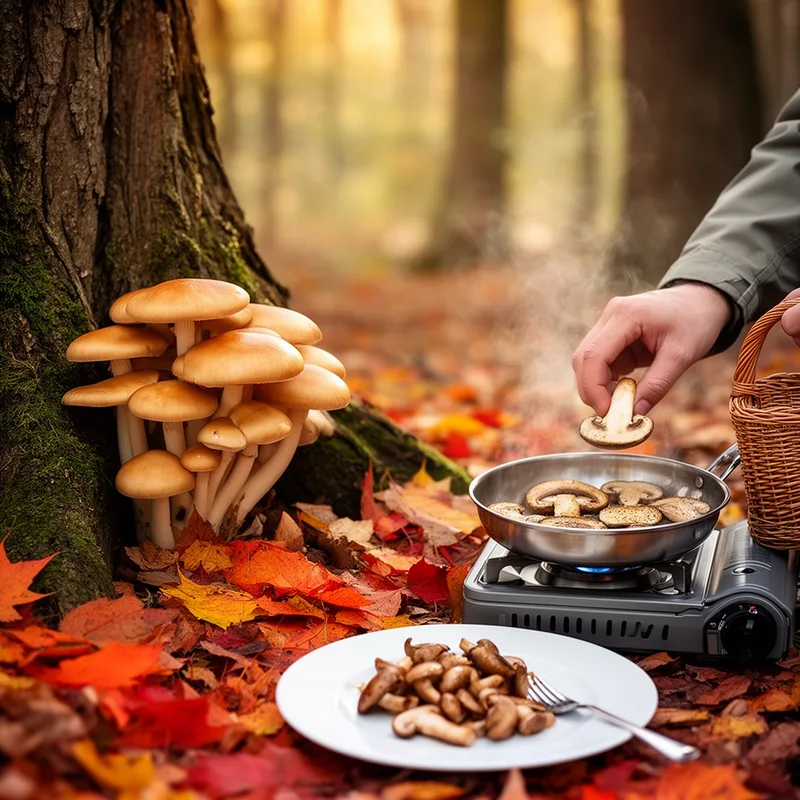
Armillariella mellea
- noun
- /ɑrˌmɪləˈriːələ ˈmɛliə/
- Specialized
- You should never eat Armillariella mellea raw, as it can cause stomach upset.
Examples
-
The woods were filled with Armillariella mellea growing around the roots of dying trees.
-
Foragers often seek out Armillariella mellea in the fall for its rich, earthy flavor.
-
Look at how many Armillariella mellea are growing here!
-
I found some Armillariella mellea while hiking in the woods.
-
Foragers often seek out Armillariella mellea in the fall for its rich, earthy flavor.
-
The woods were filled with Armillariella mellea growing around the roots of dying trees.
-
You should never eat Armillariella mellea raw, as it can cause stomach upset.
Synonyms

A honey-colored edible mushroom that grows near tree roots in late summer and autumn and must be cooked before eating

An edible mushroom with honey-colored caps that grows at tree bases and must be cooked before eating
Surface Forms
Morphology
Armillariella + mellea
This is a Latin binomial (a scientific species name) rather than a compositional English phrase; its meaning refers to a specific taxon and depends on taxonomic or Latin-epithet knowledge (the epithet 'mellea' is not an ordinary English word here). Even if a learner knew the brief genus gloss, a B1 learner who only knows ordinary English constituent meanings would not reliably infer this specific mushroom referent, so the expression is not transparently compositional.
Etymology
Armillariella mellea comes from Latin words armilla meaning 'bracelet' and mellea meaning 'honey-coloured', because the mushroom often has a ring on its stem and a warm honey colour. So the name gives a simple picture of a honey-coloured mushroom with a bracelet-like ring, which helps you remember this edible species.

