
Arequipa
 1
6.7

- proper noun
- /ˌɑːrɛˈkiːpə/
- In contrast to the city farmers, who are struggling to keep water flowing to their fields, urban dwellers in Arequipa struggle for access to fresh drinking water.
- Arequipa, Peru
- water management in Arequipa
- Arequipa's farmers
Examples
-
In the city of Arequipa, state institutions are rather strong and present, and tariffs are not disputed but acknowledged as necessary.
Academic text (2016) -
We gathered in Arequipa, Peru, in the middle of July.
Academic text (2003) -
I was already very close to the party in Arequipa where this story began.
Academic text (1993) -
I joined the party in Arequipa.
Academic text (1993) -
Located 2,400 meters above sea level, the regional capital Arequipa is Peru's second largest city, with one million inhabitants.
Academic text (2016) -
For example, I was very impressed by the Arequipa uprising in 1950 (Guzman was born on 3 December 1934).
Academic text (1993) -
Arequipa's local farmers in particular have criticized these changes at the meetings and workshops that ANA has organized in Arequipa to introduce the law and new water culture.
Academic text (2016) -
We then discussed three ethnographic cases from the Arequipa region that, in different ways, demonstrate how people relate to water and how they respond to water tariffs and the new water culture.
Academic text (2016) -
To the farmers, such a culture and its requirement to use water more efficiently will imply a change from gravity-fed irrigation, which is common in Arequipa, to modern technologies such as sprinkler and drip irrigation.
Academic text (2016) -
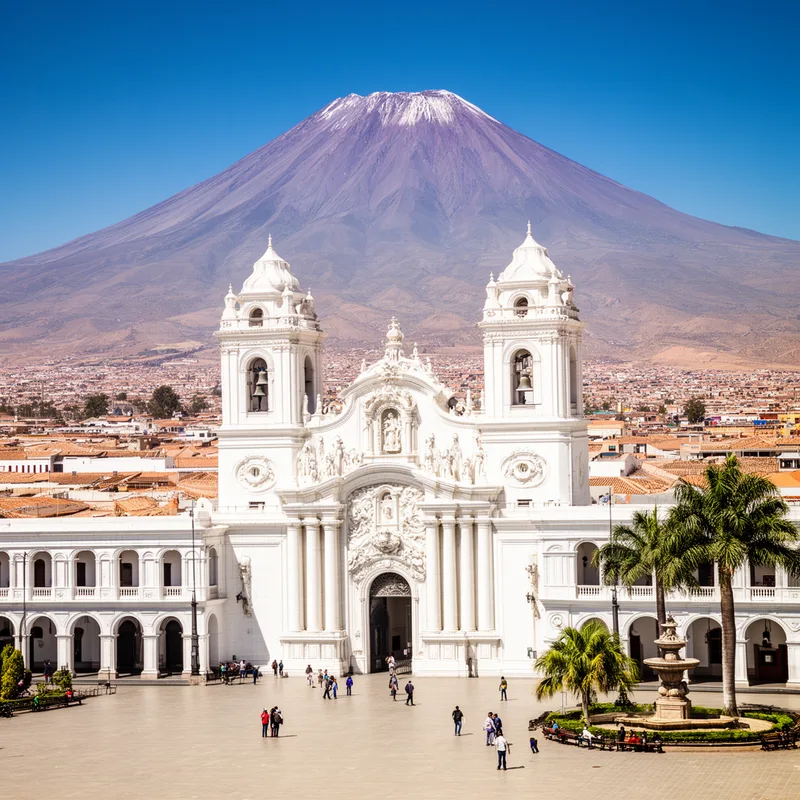
The city of Arequipa, known for its colonial architecture, is a beautiful destination in southern Peru.
Surface Forms
Etymology
Arequipa comes from a native Andean language, probably Quechua. A helpful way to remember it is to break it into ari 'behind' and qipa 'peak' or 'hill', so Arequipa means 'the place behind the mountain', which fits the city's location near tall volcanoes.