

Arenga pinnata
- proper noun
- Specialized
 :
arenga pinnata
:
arenga pinnata
- The Arenga pinnata is widely cultivated for its sweet sap, which can be fermented into palm wine.
Examples
-
Traditional sago is often made from the trunk of the Arenga pinnata palm.
-
Local artisans use fibers from Arenga pinnata to weave strong ropes and baskets.
-
The Arenga pinnata tree is native to Southeast Asia.
-
Many local communities rely on Arenga pinnata for their livelihood.
-
Local artisans use fibers from Arenga pinnata to weave strong ropes and baskets.
-
The Arenga pinnata is widely cultivated for its sweet sap, which can be fermented into palm wine.
-
Traditional sago is often made from the trunk of the Arenga pinnata palm.
Synonyms
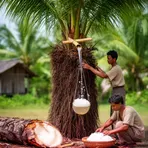
A palm tree with a fibrous base that gives sweet sap for wine and a trunk used to make sago

A palm tree whose base has many fibers and gives sweet sap for wine and starchy food from its trunk

A large tropical palm tree whose sweet sap makes sugar and wine and whose trunk gives sago
Surface Forms
Morphology
Arenga + pinnata
This is a scientific binomial (genus + specific epithet) so the form is compositional: it denotes a species of the genus Arenga. However the second element 'pinnata' is a Latin botanical adjective (related to 'pinnate' = feather-like leaves) that B1 learners typically do not know, so the referential meaning is only partially recoverable even if the genus is known. Because understanding requires specialist/Latin knowledge rather than ordinary English composition, the expression is not fully transparent.
Etymology
Arenga pinnata comes from a local Malay name and a Latin word: the first part, Arenga, comes from the Malay word 'aren' for this sugar palm, and the second part, pinnata, means 'feathered' because the long leaves spread out like a feather. So the name points to a palm with feather-like leaves whose sap and fibers people use for wine, rope and sago.

