

Ardisia escallonoides
- noun
- Specialized
- Berries of the Ardisia escallonoides provide food for birds in coastal forests.
Examples
-
The Ardisia escallonoides thrives in coastal forests.
-
The Ardisia escallonoides is prized for its hard brown wood in tropical regions.
-
Botanists studied the leaf arrangement of Ardisia escallonoides in its natural habitat.
-
Many gardeners appreciate the Ardisia escallonoides for its dark berries.
-
The Ardisia escallonoides is known for its dark berries that attract various bird species.
-
In coastal forests, the Ardisia escallonoides can often be found growing among other native plants.
-
Gardeners often choose Ardisia escallonoides for its striking appearance and the wildlife it supports.
Synonyms
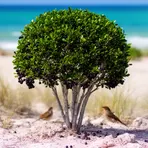
A small tree or shrub with dark berries that grows near tropical coasts in America

A tropical American bush or small tree with dark berries
Surface Forms
Morphology
Ardisia + escallonoides
This is a scientific Latin binomial composed of a genus name plus a species epithet, so a learner who knows 'Ardisia' can infer it names a kind of plant. However, 'escallonoides' is not an English word and the specific meaning or descriptive content cannot be derived by a B1 learner (the Greek/Latin suffix -oides is unlikely to be known), so the name only partially reveals its sense (type of Ardisia) but not its descriptive properties.
Etymology
Ardisia escallonoides may come from plant scientists putting together Ardisia (a plant group) and escallonoides meaning 'like Escallonia'. It gives a simple picture: the name says the plant looks 'like' another shrub, so you can remember it is a tropical shrub or small coastal tree with dark berries.

