

Arctic fox
 1
3.5
1
3.5

- noun
- /ˈɑrk.tɪk fɑks/
- Thus, as human development moves northward, so do red foxes—often moving out onto the tundra and supplanting arctic foxes as they go.
Examples
-
The arctic fox has thick, warm fur that helps it survive the freezing temperatures of its habitat.
-
We need to monitor populations in these areas and carry out research to fully understand the arctic fox's role in arctic ecosystems.
Academic text (1998) -
The arctic fox is not yet a rare species, however.
Academic text (1998) -
This biological control technique may reduce Iceland's arctic fox populations even further.
Academic text (1998) -
An average arctic fox litter contains ten offspring, or kits, as compared with the red fox's five.
Academic text (1998) -
The arctic fox was an important furbearer in Norway, Sweden, and Finland until the 1920s, when its numbers crashed.
Academic text (1998) -
Many animals of high northern latitudes, such as arctic foxes, snowshoe hares, and ptarmigans, are white in winter and brownish in summer.
Academic text (1995) -
If sheltered completely from the wind, an arctic fox in prime winter coat does not begin to shiver (that is, raise its metabolism to warm itself) until the air temperature drops below -50 Fahrenheit.
Academic text (1998) -
Among the attributes enabling the arctic fox to tolerate such bone-chilling cold are small size and foreshortened body proportions, which reduce heat loss by minimizing surface area.
Academic text (1998) -
PHOTO (COLOR): Rounded ears, dense underfur, and fur on the soles of their feet help keep arctic foxes warm at temperatures as low as -50 degrees Fahrenheit.
Academic text (1998)
Synonyms
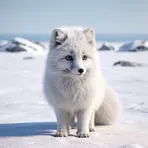
A small fox with very thick fur that lives in the far north and turns white in winter
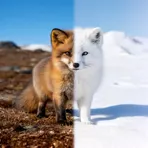
A small Arctic fox with brown summer fur and white winter fur

A former scientific name for the arctic fox
Surface Forms
Morphology
The meaning is directly compositional: 'Arctic' specifies the region and 'fox' names the animal, so a learner who knows both words can infer it is a fox native to the Arctic. This adjective + noun pattern is regular and cross-linguistically common, making the phrase immediately understandable to a B1 learner.
Etymology
Arctic fox is a simple name: Arctic means the very cold area and fox is the small wild animal. Picture a little fox turning white in winter to hide in the snow, and you can see why the name means 'a fox native to Arctic regions with thick fur that changes seasonally'.