
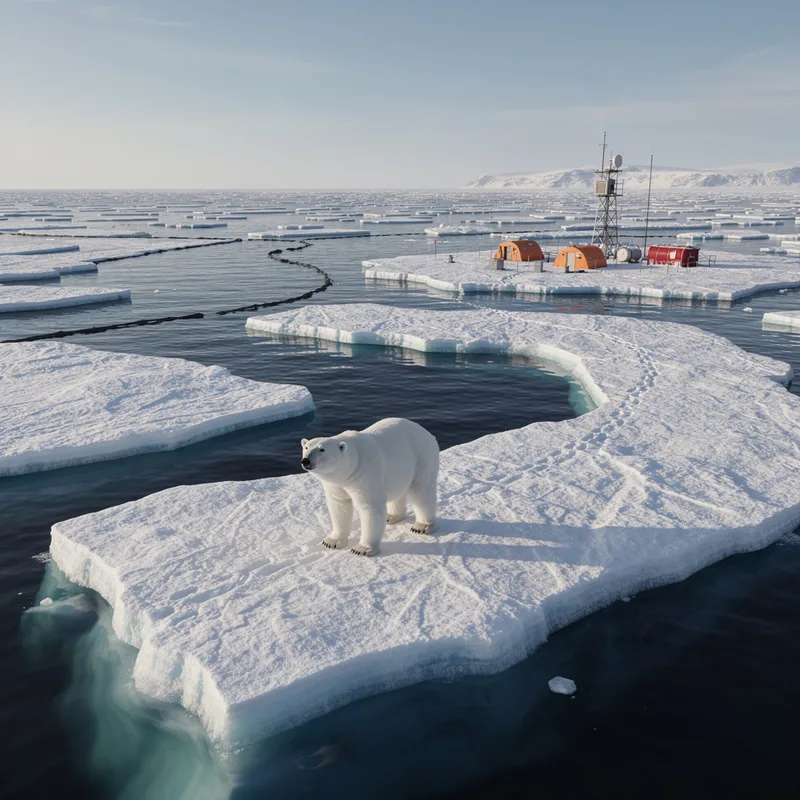
Arctic Ocean
 10
3.2

- proper noun
- /ˈɑrk.tɪk ˈoʊ.ʃən/
- Picture this: You're out on a ship in the middle of the Arctic Ocean.
- ice on the Arctic Ocean
Examples
-
The center of the storm at that date was located in the middle of the Arctic Ocean.
Blog text (3) -
The expedition was sent to look for oil and natural gas in the Arctic Ocean.
-
It's all Arctic Ocean and ice.
-
By 1990, only about 30% of the Arctic Ocean was covered by older, thicker sea ice.
Blog text (9) -
Meanwhile, surface temperatures in the Arctic Ocean during the summer were the highest in seventy-seven years of record-keeping.
Academic text (2008) -
The average thickness of Arctic Ocean sea ice is 3 meters, and it can drift as much as 20 kilometers per day.
Academic text (2000) -
Confirming earlier research, scientists reported that global warming is altering the ecology of the Arctic Ocean on a huge scale.
Academic text (2017) -
He intends to explore the Arctic Ocean and discover Sanikov Land, a near mythical landmass rumoured to lie north of the Novosibirsk Islands.
-
The expedition was sent to look for oil and natural gas in the Arctic Ocean.
-
We're at Drew Point, Alaska, on the edge of the Arctic Ocean.
Surface Forms
Morphology
The meaning is directly compositional: 'Arctic' (the region north of the Arctic Circle) combined with 'ocean' (a large saltwater body) yields the ocean around the North Pole, so a B1 learner knowing both words can infer the referent. This type of geographic name is a common, cross-linguistic descriptive pattern rather than an idiom, making it clearly transparent.
Etymology
The name Arctic Ocean comes from a Greek word for 'bear' because people long ago used a bear-shaped group of stars to show the north. So Arctic came to mean 'northern' and Ocean means the big sea around the North Pole.