
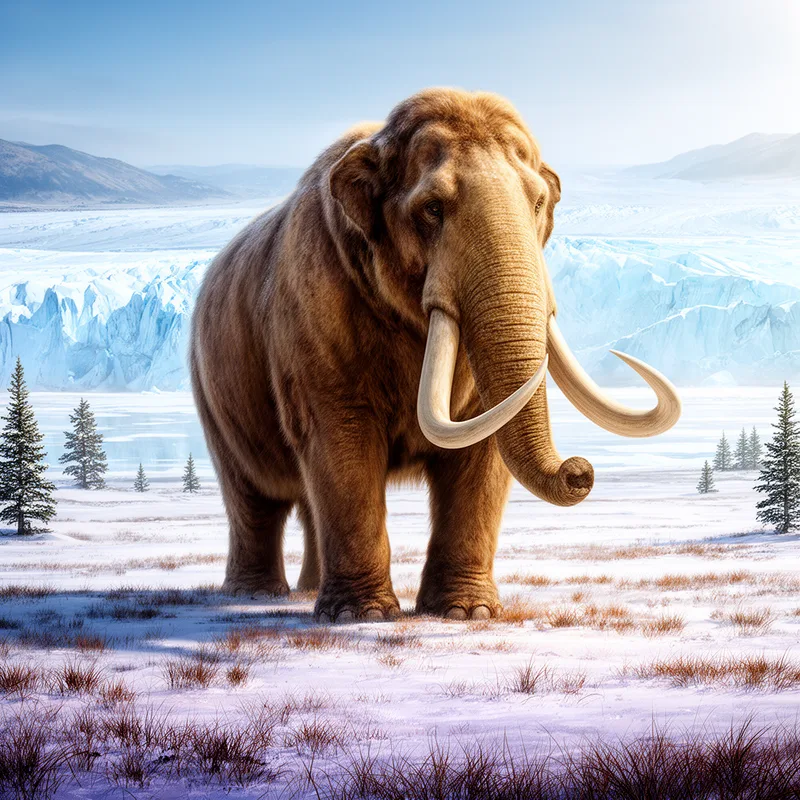
Archidiskidon imperator
- noun
- Specialized
 :
Archidiskidon imperator
:
Archidiskidon imperator
- Fossils of the Archidiskidon imperator reveal that it was one of the largest land mammals ever to roam North America.
Examples
-
The massive tusks of Archidiskidon imperator have been found in several parts of the southwestern United States.
-
Many paleontologists study the Archidiskidon imperator to understand the evolution and extinction of mammoths.
-
The Archidiskidon imperator was the largest known mammoth species.
-
Did you know that the Archidiskidon imperator roamed North America?
-
Fossils of the Archidiskidon imperator reveal that it was one of the largest land mammals ever to roam North America.
-
Many paleontologists study the Archidiskidon imperator to understand the evolution and extinction of mammoths.
-
The massive tusks of Archidiskidon imperator have been found in several parts of the southwestern United States.
Synonyms

A very large extinct animal with long tusks that lived in North America during the Ice Age

A very large extinct elephant-like animal that lived in North America during the Ice Age
Surface Forms
Morphology
As a Linnaean binomial the name transparently combines a genus ('Archidiskidon' = an extinct elephantid) with a species epithet ('imperator' = emperor), so a learner who knows both constituents can infer it refers to a particular extinct elephant/mammoth species. However, the specific claim that it is "the largest known mammoth" is not derivable from the constituent meanings; the epithet 'imperator' only metaphorically suggests prominence, making the overall interpretation only partly predictable.
Etymology
Archidiskidon imperator uses old language parts like archi- ('chief' or 'very big') and imperator ('emperor'), so the name paints a picture of a giant, ruler-like mammoth. That's why the name fits a very large extinct mammal.

