
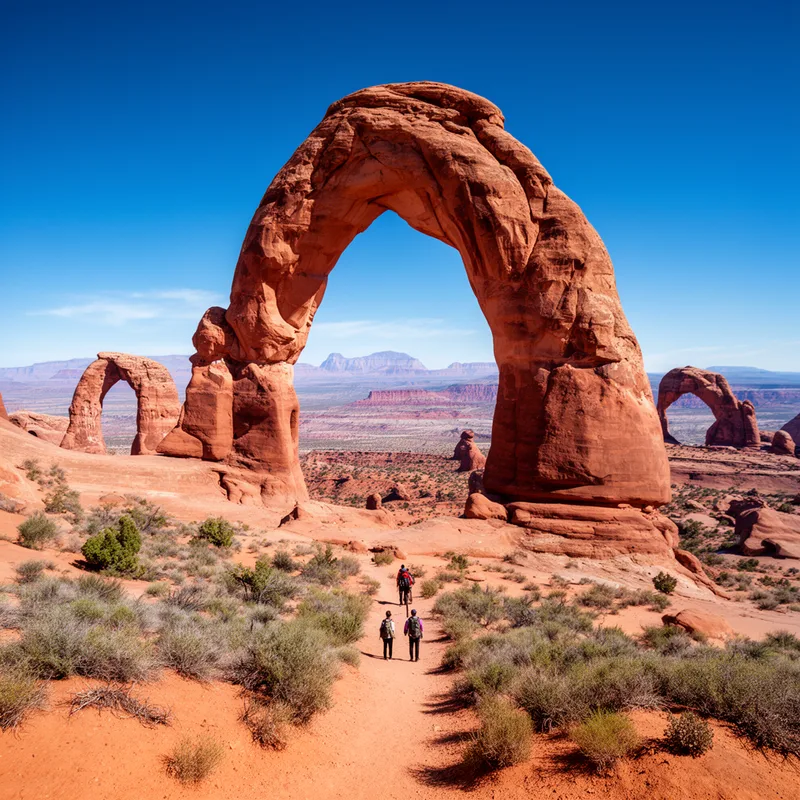
Arches National Park
- proper noun
- /ˈɑːr.tʃɪz ˈnæʃ.ən.əl pɑːrk/
- While visiting Arches National Park, I was amazed by the stunning sandstone formations and breathtaking landscapes.
- Arches National Park in Utah
Examples
-
During my hike through Arches National Park, I encountered several unique rock formations that showcased the area's geological history.
-
I start to compare the geologic events that shaped Arches National Park with the unseen celestial lights that surround me.
Academic text (2011) -
It's approaching midnight on Christmas Eve, and I am standing absolutely alone in Arches National Park in southeastern Utah.
Academic text (2011) -
Star trails photograph of the Big Dipper with Balanced Rock in the foreground. Double Arch in Arches National Park, Utah.
Academic text (2011) -
Such imperceptible forces gradually weakened a portion of another famous structure in Arches National Park, Landscape Arch, which led to the catastrophic loss of three large pieces of rock—one in 1991 and two others in June 1995.
Academic text (2011) -
The view of Delicate Arch at sunset is one of the most iconic sights in Arches National Park.
Surface Forms
Morphology
The phrase composes directly from its parts: 'arches' (rock formations), plus the compound 'national park' (a protected park at the national level), so a learner who knows the constituent words can infer it is a nationally designated park notable for arches. This type of place-name formation is cross-linguistically common, and despite being a proper name the meaning is transparently built from the constituents.
Etymology
Arches National Park is named for its many natural stone arches, where wind and water slowly wore the rock into curved openings that look like doorways. That's why the park is famous for these arches and attracts visitors who come to see the unusual rock shapes.

