
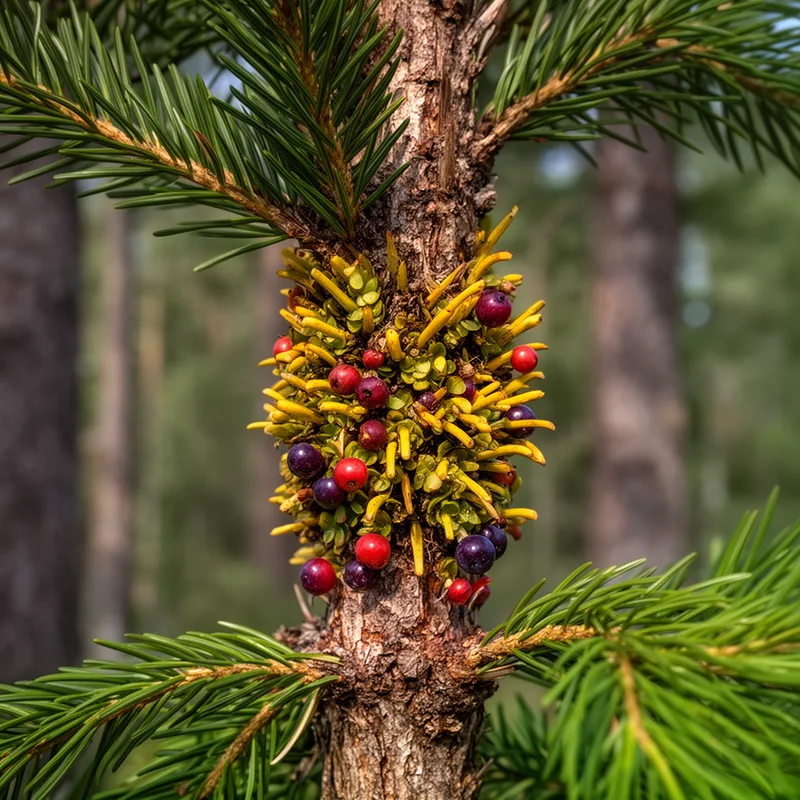
Arceuthobium pusillum
- noun
- Specialized
- Arceuthobium pusillum is a type of parasitic plant that grows on spruce and larch trees.
Examples
-
The tiny berries of Arceuthobium pusillum are a key feature used for its identification.
-
Researchers are studying methods to control the spread of Arceuthobium pusillum on larch trees.
-
Arceuthobium pusillum can cause significant damage to spruce forests in North America.
-
The Arceuthobium pusillum is often found on spruce trees.
-
Have you seen the Arceuthobium pusillum growing near the larch?
-
Ecologists are concerned about the effects of Arceuthobium pusillum on forest health in the region.
-
In the winter, the Arceuthobium pusillum is easier to spot due to its distinctive red berries.
Surface Forms
Morphology
Arceuthobium + pusillum
This is a scientific binomial combining Arceuthobium (a genus of parasitic dwarf mistletoes) with the epithet pusillum, which in Latin means 'very small'. If a learner knows Arceuthobium as a parasitic plant and understands pusillum as 'small', the compound meaning 'a small species of Arceuthobium / a small parasitic herb' is directly derivable. Binomial Latin names are compositional and follow a regular pattern, so the sense is transparent to learners who know the constituents.
Etymology
Arceuthobium pusillum comes from the plant's scientific name and describes a very small tree parasite. The first part, Arceuthobium, refers to dwarf mistletoes that live on trees and the second part, pusillum, is Latin for 'tiny', so the name helps you remember it is a very small parasite on spruce and larch trees.

