
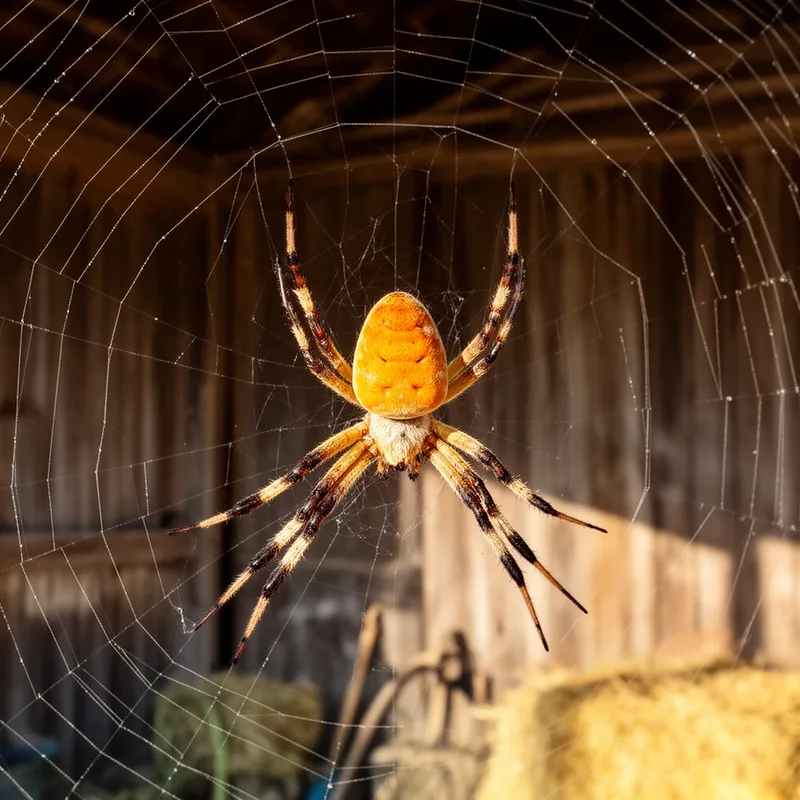
Araneus cavaticus
- noun
- /əˈreɪniəs kəˈvætɪkəs/
- Specialized
- The Araneus cavaticus is often found spinning its web in barns during late summer.
Examples
-
The Araneus cavaticus spins intricate webs in the corners of barns.
-
Farmers appreciate the presence of Araneus cavaticus because it helps control flying insect populations.
-
Many children recognize the Araneus cavaticus as Charlotte from the famous novel 'Charlotte's Web'.
-
Have you ever seen an Araneus cavaticus up close?
-
The Araneus cavaticus is known for its ability to spin a large, intricate orb web that is often found in barns.
-
During late summer, you might see an Araneus cavaticus delicately weaving its web in a cozy barn corner.
-
Farmers value the Araneus cavaticus for its role in controlling pests by catching flies in its strong webs.
Synonyms
A large orange and tan spider often found in barns that makes a new round web each day
Surface Forms
Morphology
Araneus + cavaticus
This is a Latin scientific name (a taxonomic binomial) rather than a compositional English phrase; even if a learner knew 'Araneus' means a genus of orb-weaving spiders and somehow knew 'cavaticus' is a Latin epithet, the common name 'barn spider' and the descriptive sense are not transparently derivable. Taxonomic proper names and specialist Latin epithets are non-compositional for a B1 learner and require specific biological knowledge, so the expression is opaque.
Etymology
Araneus cavaticus is an orange-tan spider often called the 'barn spider' because it lives in barns and spins round webs there to catch insects. This simple image of a spider in a barn making a round web explains the name and why people often think of 'Charlotte's Web'.

