
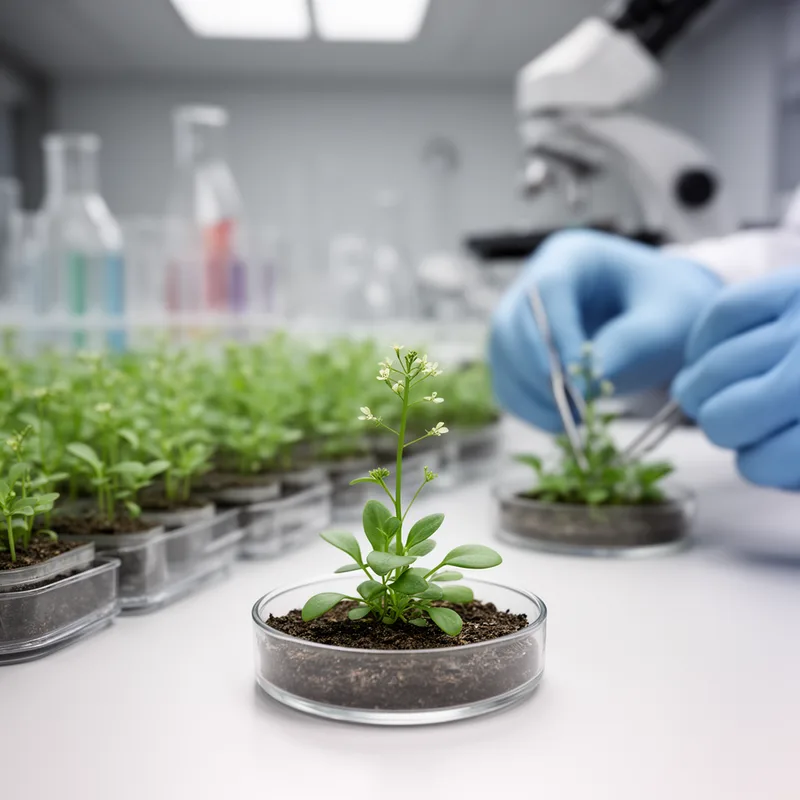
Arabidopsis
 1
9.7
1
9.7

- noun
- /ˌærəˈbɪdɒpsɪs/
- Specialized
- Scientists often use Arabidopsis as a model organism to study plant biology and genetics.
- Arabidopsis thaliana
- Arabidopsis gene
Examples
-
There are other candidate photoreceptors in Arabidopsis that look as if they feed into circadian pathways as well, says McClung.
Academic text (2005) -
Using this technology, scientists have been able to study expression patterns of Arabidopsis circadian mutants.
Academic text (2005) -
As before, most progress has been made in the non-crop model plant Arabidopsis, although this progress has been slow.
Academic text (2010) -
And we found that because the Arabidopsis genome has been fully sequenced, we can move this sort of science along quite quickly.
-
In 2001, scientists sequenced the genome of a plant named Arabidopsis thaliana.
Academic text (2002) -
Currently, Yang's studies are underway to understand the mechanisms responsible for storing or excluding nickel in Arabidopsis.
Academic text (1995) -
Plants and animals have many more genes than do simpler organisms: both Arabidopsis and people have about 25,000 genes, compared to the 3,000 in bacteria.
Academic text (2006) -
One-fourth of the pieces, or amino acids, that make up the protein from the Arabidopsis gene exactly match those produced by the TMV-resistance gene.
Academic text (1995) -
Peripheral oscillators in the weed Arabidopsis thaliana can also be entrained directly by light, through at least seven different photoreceptors, and probably more.
Academic text (2005) -
In addition, natural variation in Arabidopsis contributes to splicing changes in the proline synthesis enzyme (P5CS1) affecting drought-induced proline accumulation.
Academic text (2017)
Compounds

- Specialized
A small flowering plant in the mustard family used in labs to study plant genes and growth
- Specialized
A small wild plant with white flowers often used in genetic studies
Surface Forms
Morphology
Arabidopsis = Arabis (opaque) = arabid + opsis
A Latin/Greek botanical name formed from a genus name + the classical suffix '-opsis' and containing a connecting segment; the resulting scientific name is not transparently meaningful to average learners.
Etymology
Arabidopsis comes from the name of a related plant Arabis and the Greek part -opsis meaning 'appearance' or 'looks like'. So Arabidopsis means 'looks like Arabis', which helps you remember it is a small plant often used as a model in research.