
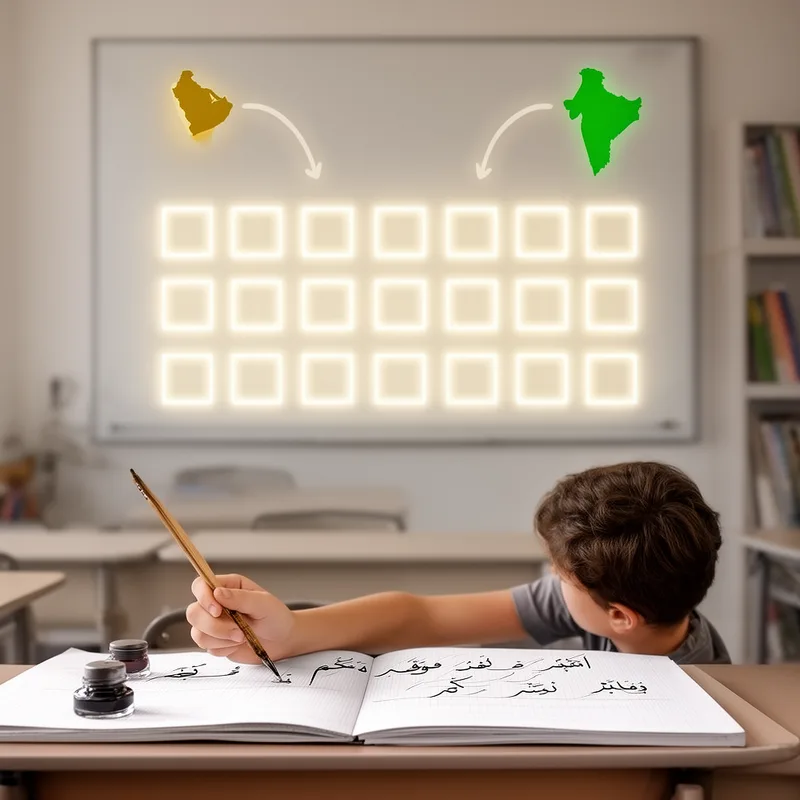
Arabic alphabet
- noun
- /ˈærəbɪk ˈælfəˌbɛt/
- The Arabic alphabet was similarly employed as a magic language in medieval Islamic occult and mystical practices, as seen in a section of the Ghaya, which documents a purportedly ancient magic script based on the Arabic alphabet.
Examples
-
The use and application of the Arabic alphabet to Turkish writing led to a series of practical problems, such as illiteracy and ambiguous communication.
Academic text (2004) -
" Well, I can't read the Arabic alphabet too well."
Fiction book (1996) -
In short, the Arabic alphabet was far too precious to give up, even when the language itself was virtually lost.
Academic text (1995) -
As mentioned earlier, during the Ottoman Empire, the native language was Turkish, but the Arabic alphabet was used.
Academic text (2004) -
If the need to shift to Spanish was obvious, given the Mudejares' ignorance of Arabic, why retain the Arabic alphabet?
Academic text (1995) -
In an ambitious drive to import European civilization wholesale, the republic disposed of the caliphate, the Arabic alphabet, Islamic education, and the Sufi brotherhoods.
Academic text (2007) -
The Arabic alphabet was similarly employed as a magic language in medieval Islamic occult and mystical practices, as seen in a section of the Ghaya, which documents a purportedly ancient magic script based on the Arabic alphabet.
Academic text (2008) -
In light of this affiliation, it is a distinct possibility that the maker of the S. Marco bowl sought to enhance the object's divinatory power by employing a pseudo-inscription derived from the Arabic alphabet.
Academic text (2008) -
Inspired by the forms and shapes of the Arabic alphabet, Rachid Korachi is intrigued by the mystic traditions of Sufism and its appreciation of letters as signs and gestures.
Academic text (2007) -
The Arabic alphabet consists of 28 letters used for writing the Arabic language.
Surface Forms
Morphology
The meaning is directly and compositionally derived from 'Arabic' (the language) + 'alphabet' (set of letters): a B1 learner who knows both words can infer it refers to the writing system of Arabic. This pattern (language name + alphabet) is cross-linguistically common and follows standard noun-noun compounding, so the MWE is immediately understandable.
Etymology
Arabic alphabet combines Arabic (the language) and alphabet (a set of letters); these 28 letters grew from an older script called Aramaic and were shaped to fit Arabic sounds. That's why Arabic alphabet now means the set of letters used to write Arabic and, later, other languages like Urdu.

