
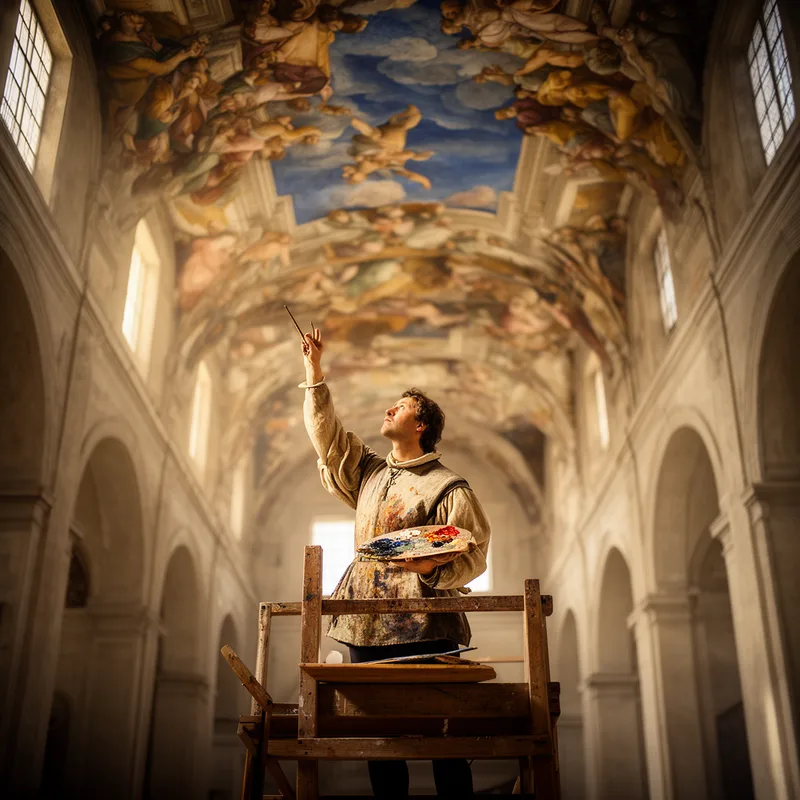
Antonio Allegri da Correggio
- proper noun
- Visitors to Parma can admire several masterpieces by Antonio Allegri da Correggio in local churches.
Examples
-
The use of light and shadow by Antonio Allegri da Correggio deeply influenced later Baroque artists.
-
Many art historians consider Antonio Allegri da Correggio a master of illusionistic ceiling painting.
-
Antonio Allegri da Correggio is fascinating.
-
Look at Antonio Allegri da Correggio!
-
Art lovers from around the world travel to Italy to see the works of Antonio Allegri da Correggio in various galleries.
-
The innovative techniques of Antonio Allegri da Correggio revolutionized how light is depicted in painting.
-
Scholars often study the paintings of Antonio Allegri da Correggio for their extraordinary use of perspective.
Synonyms



 1
9.9
An Italian painter of the High Renaissance who used soft light and strong perspective

An Italian painter of the Renaissance who used strong light and perspective
Surface Forms
Morphology
Antonio + Allegri + da + Correggio
This is a full proper name (an historical Italian painter) rather than a compositional phrase, so knowing the constituent tokens does not allow a B1 learner to infer the referent or profession. The element 'da' is an Italian preposition and the other components are names/place-names, so the overall meaning (a specific painter, dates, artistic significance) is not derivable from the parts.
Etymology
Antonio Allegri da Correggio comes from his birthplace: 'da Correggio' simply means 'from Correggio', a small town near Parma. He became famous for paintings with strong light and shadow and for ceiling scenes that look like the sky, so the name helps you remember he was an Italian painter known for dramatic, illusion-like works.