
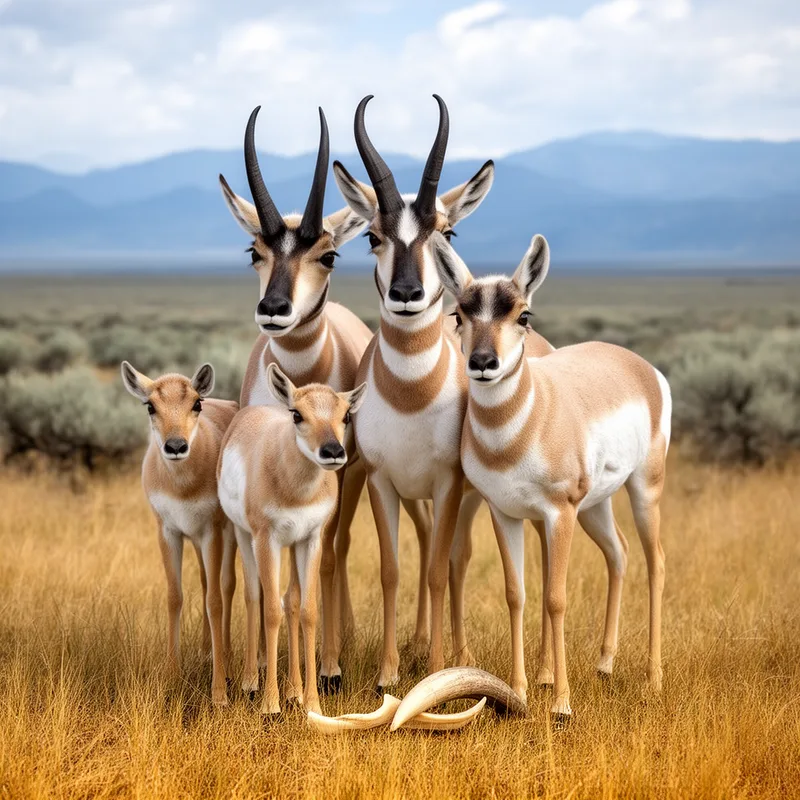
Antilocapridae
- noun
- /ˌæntɪloʊˈkæprɪdeɪ/
- Specialized
- The Antilocapridae are native to North America and include only the pronghorn species.
Examples
-
Unlike deer, members of the Antilocapridae family shed their horns annually.
-
The Antilocapridae family is unique to North America.
-
Scientists have studied the evolutionary history of the Antilocapridae for decades.
-
Did you know that Antilocapridae are the fastest land mammals in North America?
-
The Antilocapridae family is known for its distinctive pronghorns, which can be found across the North American plains.
-
Species within the Antilocapridae demonstrate remarkable adaptations to their environment, allowing them to thrive in various habitats.
-
Many researchers focus on the Antilocapridae to understand better the evolutionary biology of fast-running mammals.
Surface Forms
Morphology
Antilocapridae = Antilocapra (opaque) = Antilocapra + idae
The form is a Latinized genus name with the specialized zoological family suffix '-idae', a formation unfamiliar to average learners and not derivable from common English words.
Etymology
Antilocapridae comes from parts that mean 'different from' (anti-) and 'goat' (capra), with -idae showing a family name, so it can be read as 'not a goat'. A helpful way to remember this is that the Antilocapridae are a unique North American family that includes only the pronghorn, an animal that looks a bit like a goat or antelope but belongs to its own family.

