
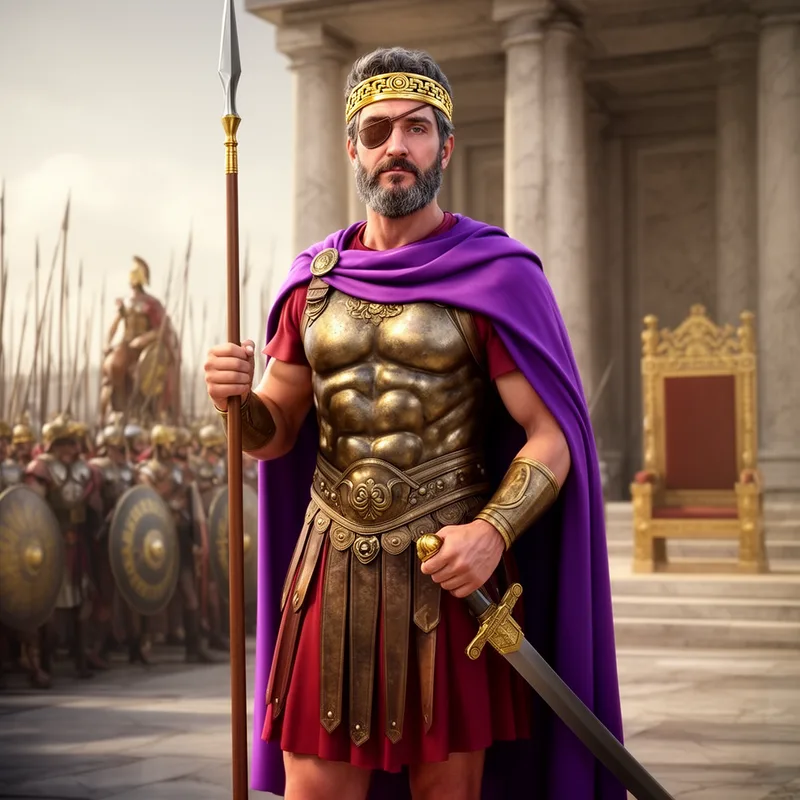
Antigonus I Monophthalmus
- proper noun
- The defeat of Antigonus I Monophthalmus at the Battle of Ipsus marked the end of his ambitions for empire.
Examples
-
Antigonus I Monophthalmus rose to power following the death of Alexander the Great.
-
Studying the actions of Antigonus I Monophthalmus offers insight into the power struggles of early Hellenistic rulers.
-
Antigonus I Monophthalmus was a great leader.
-
What did Antigonus I Monophthalmus achieve?
-
Antigonus I Monophthalmus became a prominent figure in history due to his role in the wars following Alexander the Great's death.
-
Antigonus I Monophthalmus established himself as a rival to other Hellenistic leaders after the fragmentation of Alexander's empire.
-
Antigonus I Monophthalmus's legacy is often discussed in the context of the Hellenistic period's military strategies.
Synonyms

A Macedonian general under Alexander the Great who lost one eye and died at the Battle of Ipsus
Surface Forms
Morphology
Antigonus + I + Monophthalmus
This is a proper name with a Greek epithet and a Roman numeral; the historical identity and details (Macedonian general, lost one eye, reign) are not compositional from the surface parts. 'Antigonus' and 'Monophthalmus' are lexical items that do not convey their referential/historical meaning to a B1 learner, and 'I' is ambiguous (roman numeral vs pronoun), so the overall meaning is not derivable from the constituents.
Etymology
Antigonus I Monophthalmus includes the nickname Monophthalmus, which means 'one-eyed' because he lost an eye in battle. That nickname helps people remember him as the one-eyed general who became king and later died at the Battle of Ipsus.

