

Antarctic expedition


 1
6.3
1
6.3
- noun
- /ænˈtɑrktɪk ˌɛkspəˈdɪʃən/
- The majority of the dead, buried in shallow pits pried from the rocks, came from a Norwegian Antarctic expedition after their ship was crushed in the ice in 1859.
Examples
-
Scientists on the research vessel Polarstern completed a seven-month Antarctic expedition to study climate change.
-
And most of the Antarctic expedition companies do not organize tours after February.
Blog text (17) -
For example, on Shackleton's march across South Georgia during his famous Antarctic expedition, all three members of the team reported feeling the presence of an extra, fourth man near them at all times.
Blog text (3) -
History teachers can use the historical information to compare historic Antarctic expeditions to UAB's expeditions.
Academic text (2004) -
The early British Antarctic expeditions were the first to describe the lakes in the McMurdo Dry Valley region (e.g., Scott 1905, Taylor 1922).
Academic text (1999) -
A Stalin-era intelligence file released in 1991 revealed that Admiral Byrd's Antarctic expedition, Operation Highjump, did encounter and battle with a mysterious UFO force in early 1947.
Blog text (13) -
In 1914, Ernest Shackleton led his famous Antarctic expedition to explore the uncharted regions of the South Pole.
-
The team of researchers prepared for their Antarctic expedition by gathering supplies and equipment for the harsh conditions.
Synonyms
 358
4.1
358
4.1
An organized trip by a group for a special purpose like exploring or doing research
How Challenging

Surface Forms
Morphology
The meaning is directly compositional: 'Antarctic' specifies the location (near the South Pole) and 'expedition' means an organized journey, so a learner who knows both words can derive 'a journey to the Antarctic region.' This type of adjective + noun composition is cross-linguistically regular and follows standard English patterns, making it immediately comprehensible to a B1 learner.
Etymology
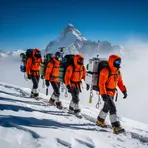
Antarctic expedition makes you picture a small team leaving a ship onto bright white ice, pulling sledges and setting up tents to study penguins and the cold. It literally means an expedition to the Antarctic, so it means 'a journey to the Antarctic region for exploration or research'.