
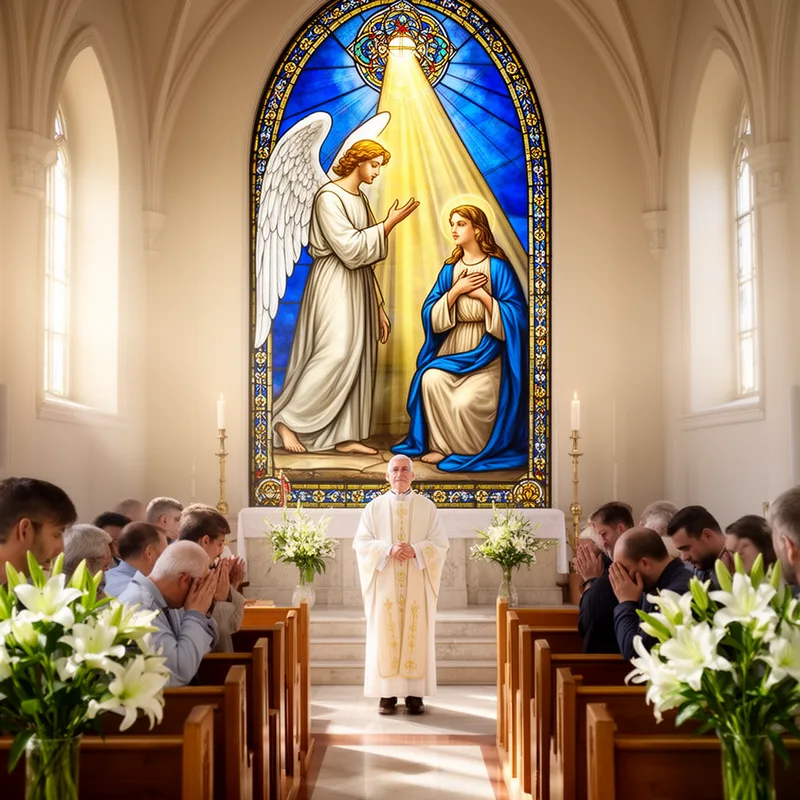
Annunciation Day
- noun
- /əˌnʌn.siˈeɪ.ʃən deɪ/
- UK
- Many churches hold special services on Annunciation Day to commemorate the angel Gabriel's message to Mary.
Examples
-
Many Christians celebrate Annunciation Day on March 25.
-
In medieval England, Annunciation Day marked one of the traditional quarter days for settling rents and accounts.
-
She read a poem each year in honor of Annunciation Day and its meaning in the Christian calendar.
-
Is Annunciation Day a public holiday in your country?
-
In medieval England, Annunciation Day marked one of the traditional quarter days for settling rents and accounts.
-
Many churches hold special services on Annunciation Day to commemorate the angel Gabriel's message to Mary.
-
Many Christians celebrate Annunciation Day on March 25.
Synonyms

 1
8.4
1
8.4

A Christian festival on March 25 that celebrates an angel telling Mary she will have a baby

A Christian festival celebrating the angel Gabriel's announcement to Mary and a traditional rent day in England

A Christian festival on March 25 that marks the angel Gabriel's message to Mary that she would become Jesus' mother
Surface Forms
Morphology
The meaning is directly and transparently derived from combining 'Annunciation' (the liturgical event/feast) with 'day' (a calendar day set aside), so a learner who knows both constituents can infer it is the day commemorating the Annunciation. This is a straightforward compositional noun phrase common in religious and calendar vocabulary and has close parallels in many other languages, supporting immediate understandability.
Etymology
Annunciation Day comes from the Bible story when the angel Gabriel told Mary she would become pregnant and bear Jesus on March 25, so people held a special church festival for that 'announcement'. Because the date was also used in old England and Ireland as a day to pay rents and settle accounts, the name now refers to the church celebration of that message.