

Andean condor
- noun
- /ˈændiən ˈkɒndɔr/
- The majestic Andean condor can be identified by its striking black feathers and distinctive white neck ruff.
- release of Andean condors
Examples
-
The Colombian releases included Andean condors that had been used in California to test methods for rearing and releasing California condors.
Academic text (1999) -
In Colombia, 57 Andean condors have been released since 1989, 35 of which still survive.
Academic text (1999) -
Unlike Andean condors, with their white neck fluff, or king vultures, with their brilliant black-and-white feathers, California condors are not much to look at.
Academic text (1999) -
Uncertainties aside, the California condor project has served as a model for releasing captive-hatched Andean condors in areas of South America where the birds were rare or eliminated due to habitat loss.
Academic text (1999) -
An earlier experimental release of Andean condors in Los Padres National Forest had shown that captive-hatched condors could survive in the wild, suggesting that zoo-raised California condors could too.
Academic text (1999) -
While hiking in the Andean mountains, we spotted an Andean condor soaring gracefully in the sky.
-
Researchers are studying the nests of the Andean condor to understand their breeding habits in the wild.
Synonyms
 42
3.3
42
3.3

A large bird with a bare head that eats dead animals
 18
5.6
18
5.6
A very large vulture with a bare head that lives in parts of the Americas
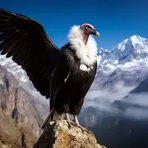
A very large vulture with black feathers and a white neck ring that lives in the high Andes
Surface Forms
Morphology
The phrase is a straightforward adjective + noun composition: 'Andean' specifies origin/connection to the Andes and 'condor' names a large vulture, so the combined meaning is simply a condor from the Andes. This type of origin/type modifier construction is common cross-linguistically and therefore immediately predictable to a B1 learner who knows both constituent words.
Etymology
Andean condor comes from linking condor (a very large vulture) with Andean (from the 'Andes' mountains). Picture a huge black bird with a white neck ruff circling high over sharp mountain peaks, and that image explains why the name means 'a very large vulture from the Andes'.