
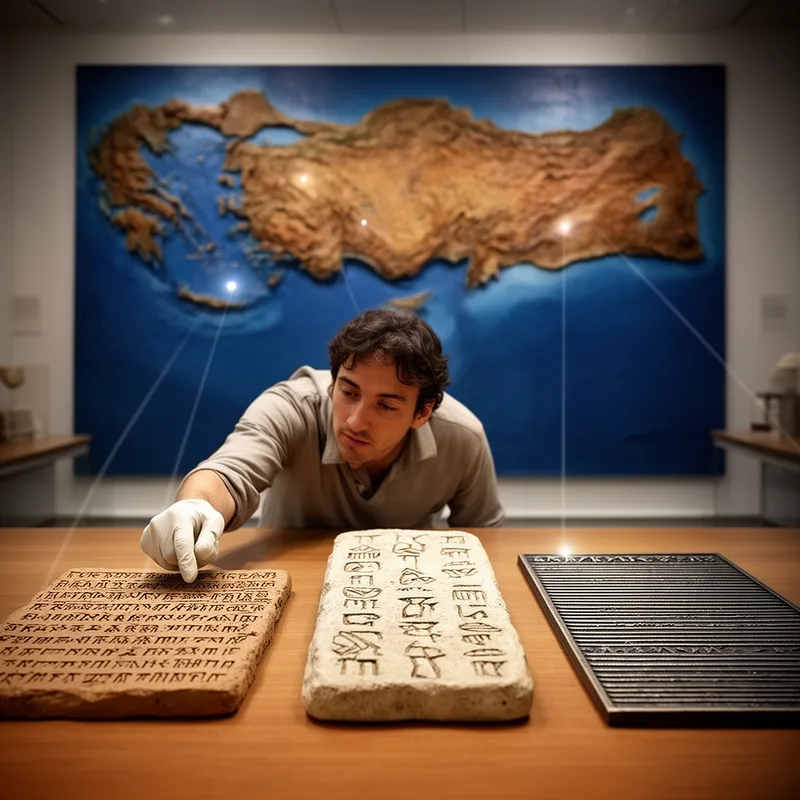
Anatolian language


 1
9.9
- noun
- /ˌænəˈtoʊliən ˈlæŋɡwɪdʒ/
- Specialized
- Many ancient inscriptions in Hittite, an Anatolian language, have been discovered in present-day Turkey.
Examples
-
Luwian, spoken in Bronze Age Anatolia, is another example of an Anatolian language.
-
The Anatolian language family includes Hittite and Luwian.
-
Linguists study the Anatolian language branch to better understand the origins of Indo-European languages.
-
Many scholars study the Anatolian languages to understand ancient cultures.
-
Linguists study the Anatolian language branch to better understand the origins of Indo-European languages.
-
Many ancient inscriptions in Hittite, an Anatolian language, have been discovered in present-day Turkey.
-
Luwian, spoken in Bronze Age Anatolia, is another example of an Anatolian language.
Synonyms
 1
9.9
An extinct group of languages once spoken in Anatolia and known from old inscriptions
Surface Forms
Morphology
The meaning is directly composed from 'Anatolian' (relating to Anatolia/Anatolia-derived) and 'language' (a speech/writing system), so a learner who knows both constituents will infer it denotes a language variety associated with Anatolia. While the scholarly nuance that it names an extinct Indo‑European branch is specialised, the basic referent is transparently derivable from the parts.
Etymology
Anatolian language comes from Anatolian, which refers to Anatolia, the area of today's Turkey where these old languages were once spoken, and language means 'a way of speaking'. These languages are now 'extinct' and survive only in old inscriptions, so the phrase refers to the ancient branch of languages from that region.