
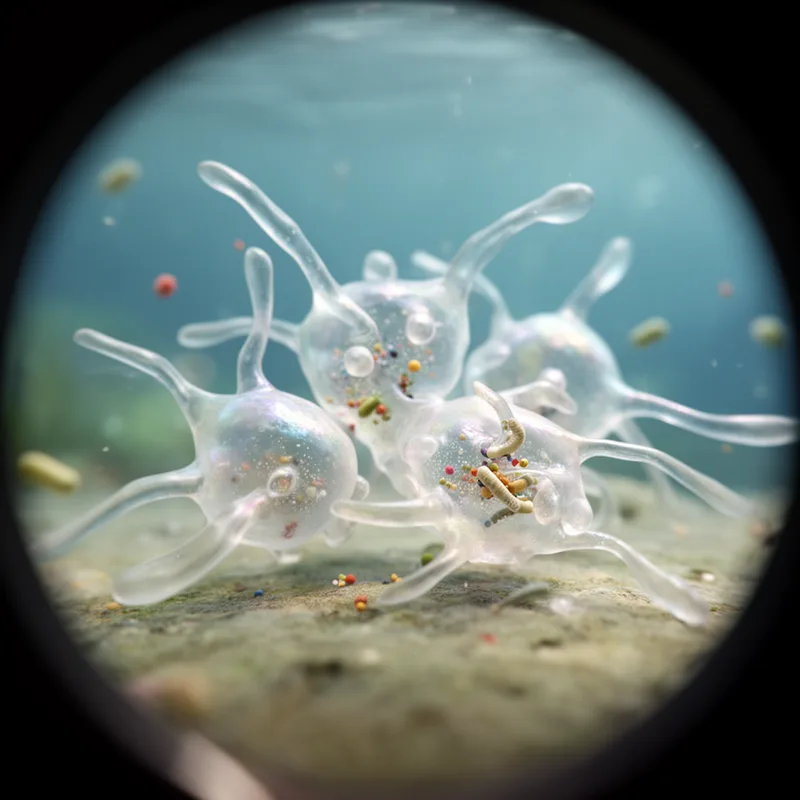
Amoebina
- noun
- Specialized
- Researchers observed unique movement patterns in several Amoebina species under the microscope.
Examples
-
The classification of Amoebina has evolved as scientists learn more about protozoan relationships.
-
Many species in the order Amoebina are found in freshwater environments.
-
The Amoebina are fascinating organisms to study.
-
Many Amoebinas can be found in freshwater environments.
-
Many species in the order Amoebina are found in freshwater environments.
-
Researchers observed unique movement patterns in several Amoebina species under the microscope.
-
The classification of Amoebina has evolved as scientists learn more about protozoan relationships.
Synonyms

Single-celled organisms like amoebas that change shape and move using false feet

A group of one-celled creatures like amoebas
Surface Forms
Morphology
Amoebina = amoeba (semi-transparent) = amoeba + ina
The formation 'amoeba' + '-ina' denotes a taxonomic group, so the relation to 'amoeba' is clear to those familiar with scientific naming but the suffix '-ina' is specialized and may be unfamiliar to average learners.
Etymology
Amoebina comes from amoeba, a word that means 'change' or 'changeable', plus the ending -ina which marks it as a group name. So Amoebina is a group of tiny single-celled creatures that change shape and move with 'false feet', and the name reminds you of their shifting bodies.

