
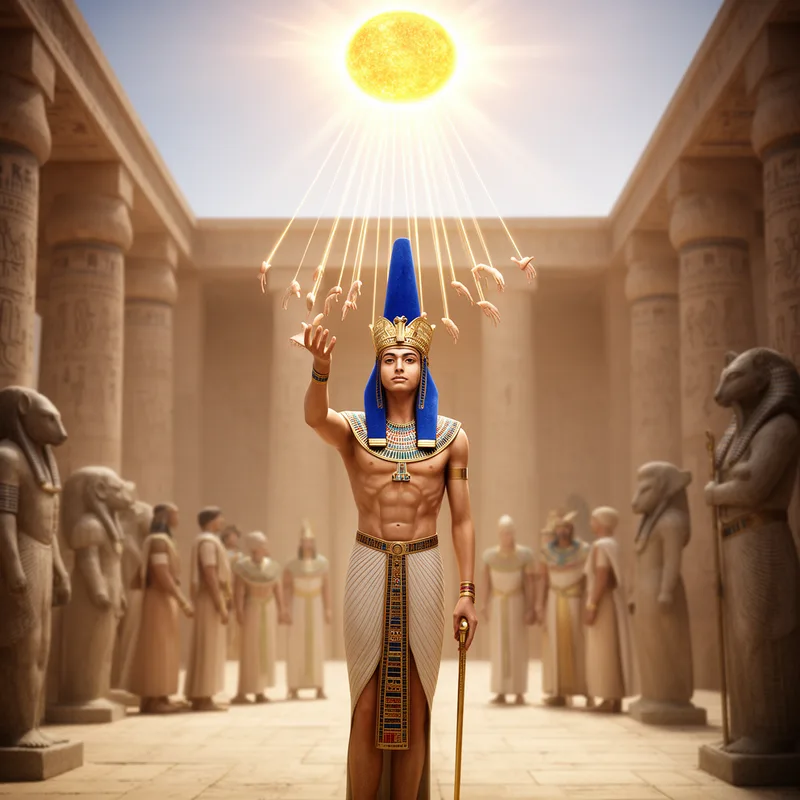
Amenhotep IV


 1
9.9
- proper noun
- Amenhotep IV is notable for introducing monotheistic worship of Aten during his reign in Egypt.
Examples
-
The art and architecture from the period of Amenhotep IV reflect major cultural changes in ancient Egypt.
-
Many scholars debate whether Amenhotep IV's religious reforms influenced later religious movements.
-
The pharaoh Amenhotep IV is famous for his religious reforms.
-
Did Amenhotep IV really change the religion of ancient Egypt?
-
Amenhotep IV is recognized for promoting the exclusive worship of the sun disc, Aten, in ancient Egypt.
-
During the reign of Amenhotep IV, the focus shifted from multiple gods to a single deity, Aten.
-
Historians study the reign of Amenhotep IV to understand the evolution of religion in ancient Egypt.
Synonyms
 7
9.9
An ancient Egyptian king who made Egyptians worship only the sun disk Aten
 1
9.9
A ruler of ancient Egypt who rejected old gods and made the sun god Aten the main god
An ancient Egyptian ruler who rejected old gods and promoted worship of the sun disc Aten
Surface Forms
Morphology
Amenhotep + IV
This is a proper name plus a numeral: knowing the parts ('Amenhotep' as a name token and 'IV' meaning four) does not let a B1 learner infer the historical role, timeframe, or the religious reforms described. The numeral only signals the fourth person with that name but does not transparently convey that this is an Egyptian pharaoh or his actions, so the meaning is idiomatic/specific and not derivable from the constituents.
Etymology
Amenhotep IV was a king who surprised Egypt by rejecting the old gods and making the sun disk 'Aten' the one true god. He even changed his name to Akhenaten, which shows 'servant of Aten', so the name reminds us he tried to make people worship only one god.