
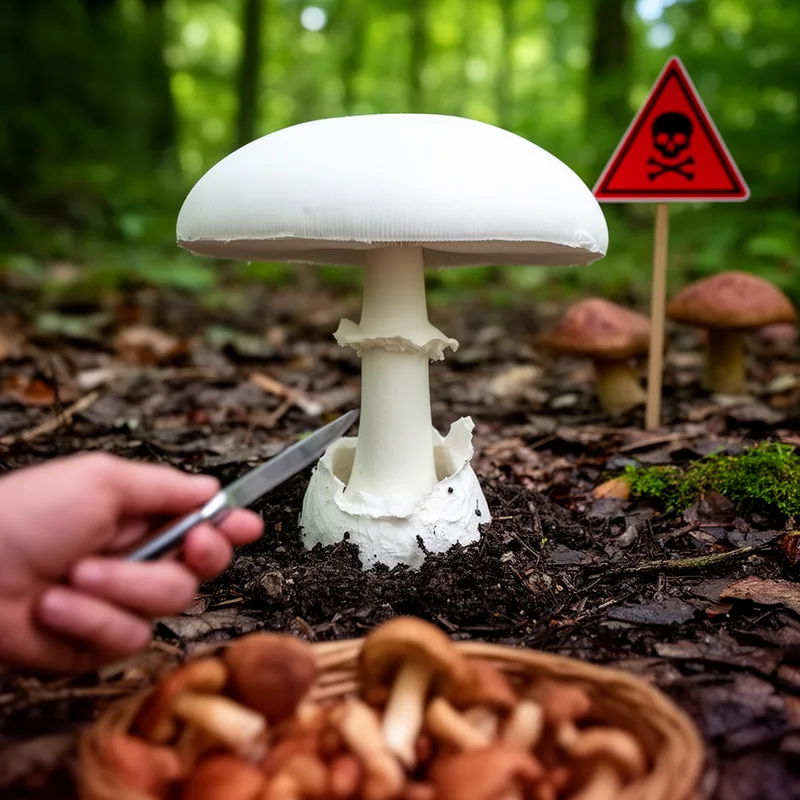
Amanita verna
- noun
- /əˈmænɪtə ˈvɜrnə/
- Specialized
- People are strongly warned not to eat Amanita verna because of its deadly toxins.
Examples
-
The Amanita verna is sometimes mistaken for edible mushrooms due to its innocent white appearance.
-
The forager was alarmed to find an Amanita verna growing near the walking trail.
-
The Amanita verna is known for its deadly toxicity.
-
Many people mistake the Amanita verna for edible mushrooms.
-
It is crucial to identify Amanita verna in the wild, as consuming it can be fatal.
-
The highly toxic Amanita verna resembles some edible mushrooms, posing a serious risk to foragers.
-
Many outdoor enthusiasts are unaware that Amanita verna is one of the most poisonous mushrooms in the world.
Synonyms

A very poisonous white mushroom that can kill you if eaten

A very poisonous white mushroom with a cup-shaped base and white gills that can kill if eaten

A very poisonous white mushroom that can kill you if you eat it
Surface Forms
Morphology
Amanita + verna
Amanita verna is a Latin scientific binomial (a proper name for a specific species), so its precise referent and properties are not compositionally derived from the parts. Even if a learner knows that Amanita names a genus of poisonous mushrooms, the specific epithet 'verna' is not transparent at B1 and the species-level meaning (a highly poisonous white 'destroying angel') cannot be inferred from the constituents, making the expression non-compositional for learners.
Etymology
Amanita verna gets its name from older words: Amanita was an old name for certain mushrooms and verna means 'spring' in Latin. So the name helps you picture a white mushroom that shows up in spring and is deadly, which is why people call it the 'destroying angel'.

