
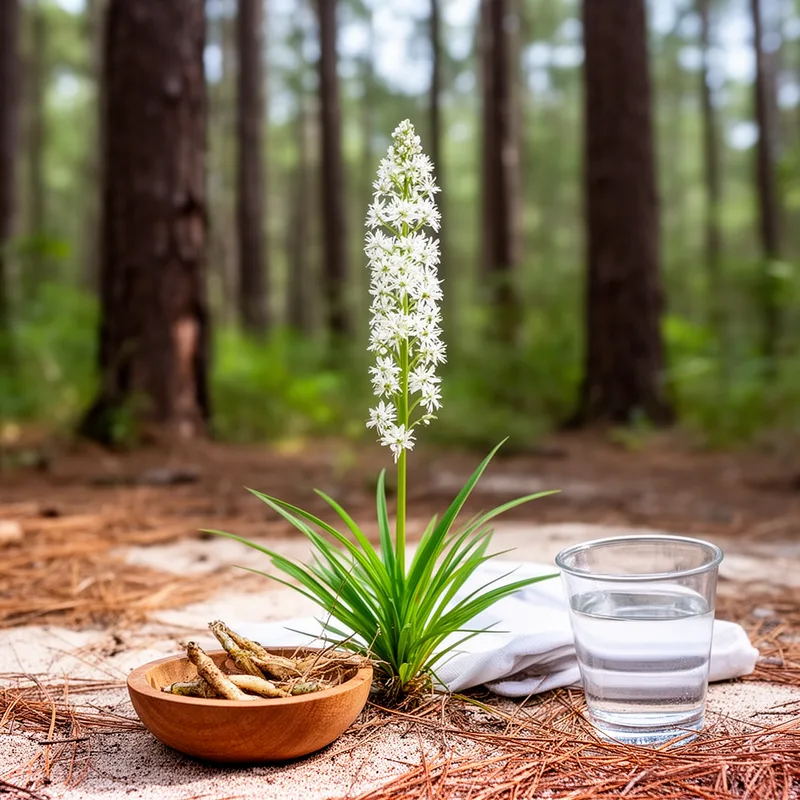
Aletris farinosa
- noun
- Specialized
- In bloom, Aletris farinosa produces a spike of small, white, star-shaped flowers.
Examples
-
The Aletris farinosa is commonly known as colicroot.
-
The sandy soils of pine woodlands are home to Aletris farinosa.
-
Aletris farinosa is valued in traditional herbal medicine for its use in treating colic.
-
In the southeastern United States, Aletris farinosa grows abundantly.
-
Aletris farinosa is commonly found in the wild and is recognized for its medicinal properties.
-
Many herbalists recommend Aletris farinosa for its effectiveness in alleviating digestive issues.
-
During spring, Aletris farinosa showcases its beautiful white flowers along forest edges.
Synonyms

A plant that lives for several years with grasslike leaves and bitter roots that people use to treat stomach pain
A North American plant with small white flowers sometimes used in herbal medicine
A herb from the southeastern United States with rough outer flower parts and small white flowers
Surface Forms
Morphology
Aletris + farinosa
This is a Latin binomial (genus + species epithet) functioning as a scientific proper name, so its status as 'a North American perennial herb' is not compositionally derived from everyday English words. Even if a learner recognised 'Aletris' as a genus label, the taxonomic Latin epithet 'farinosa' and the naming convention are not predictable to a B1 learner, making the meaning non-transparent.
Etymology
Aletris farinosa may come from the old name Aletris for a medicinal herb and the Latin word farinosa, meaning 'mealy' or 'powdery', because its small white flowers look coated in fine dust. So the name helps you remember it is a white, powdery-looking herb once used to treat 'colic'.

