
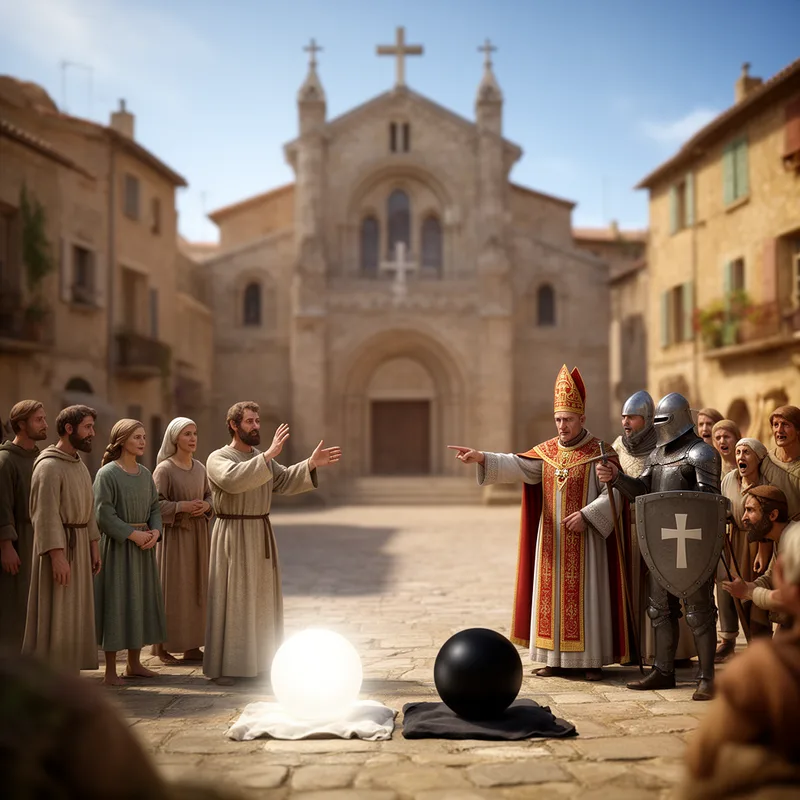
Albigensianism
- noun
- /ˌæl.bɪˈdʒɛn.i.ə.nɪ.zəm/
- Literature
- In the 13th century, the rise of Albigensianism led to the Albigensian Crusade, aimed at eradicating the movement.
Loading YouTube…
Watch on YouTubeBut he was really motivated by this, this outbreak of what came to be labeled as a heresy of Albigensianism in the South of France.
- But he was really motivated by this, this outbreak of what came to be labeled as a heresy of Albigensianism in the South of France.
Examples
-
The teachings of Albigensianism emphasized a dualistic view of the universe, contrasting the good and evil forces.
-
But he was really motivated by this, this outbreak of what came to be labeled as a heresy of Albigensianism in the South of France.
-
Historians often discuss Albigensianism as a significant heretical movement that challenged the authority of the Catholic Church.
Synonyms



 1
9.9
A medieval Christian movement in southern France that taught two opposing gods and was declared wrong by the Church
Surface Forms
Morphology
Albigensianism = Albigensian (semi-transparent) = Albigensian + ism
Morphologically regular: the adjective 'Albigensian' + the productive suffix '-ism' (denoting a doctrine or movement); however the base is a rare historical demonym tied to a specific medieval group, so the referent may be obscure to learners.
Etymology
Albigensianism comes from the name of the town Albi in southern France; the -ensian part is like Parisian, showing 'from' a place, and the -ism part means 'belief' or 'system'. So Albigensianism simply names the religious beliefs that began around Albi in the Middle Ages, which is why the word refers to that particular medieval movement.