

Afrikaner
 5
7.2
5
7.2

- noun
- /ˌæfrɪˈkɑːnər/
- They called themselves Afrikaners and spoke their own dialect of Dutch, known as Afrikans, but they were often simply known as Boers, the Dutch word for farmer.
- Afrikaners and coloureds
- Afrikaner Broederbond
- attitudes of Afrikaners
Loading YouTube…
Watch on YouTubeSo they've internalized the notion that they're bad and have they've kind of made Afrikaners out of us.
- So they've internalized the notion that they're bad and have they've kind of made Afrikaners out of us.
Examples
-
Beginning already in the 1920s and 1930s, Afrikaner businesspeople decided that Afrikaners needed to cooperate to preserve Afrikaner economic gains.
Academic text (1996) -
The Afrikaners waited for that day with excitement.
-
As an Afrikaner, you should know that better than anyone else.
-
We know that you Afrikaners have paid in blood for your country.
-
Well, we Afrikaners are funny people sometimes.
-
We Afrikaners came here in 1652.
-
As noted earlier, by the mid-1970s many Afrikaners had achieved a large measure of wealth and power.
Academic text (1996) -
During apartheid, education was the only sector in which a distinction was made between Afrikaners and English-speaking people.
Academic text (2003) -
For example, the majority of Afrikaners (approximately 70 percent) had reached a middle-class status.
Academic text (1996) -
Many Afrikaners have rich cultural traditions that celebrate their heritage.
Synonyms
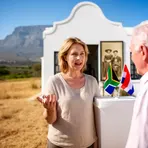
A white person from South Africa descended from Dutch settlers who often speaks Afrikaans

A white person in South Africa whose family came from Dutch settlers and speaks Afrikaans
Surface Forms
Etymology
The word Afrikaner comes from Afrika 'Africa' and the ending -er 'person from', like in New Yorker. It was used for white South Africans whose ancestors were mainly Dutch settlers and who speak Afrikaans, so today an Afrikaner is a member of that community.