

African-American music


 1
3.0
1
3.0
- noun
- /ˌæfrɪkən əˈmɛrɪkən ˈmjuːzɪk/
- US
 :
música afroamericana
:
música afroamericana
- In a Grand Masters series article in Music Educators Journal, Charles Leonhard states that too many music programs and teachers are "unfamiliar with African American music and other ethnic music."
Examples
-
The annual festival celebrates the rich heritage of African-American music through performances of jazz, blues, and gospel.
-
In fact, while Clarksdale played a key role in the development of popular American music for much of the twentieth century, it did so largely without the recognition or encouragement of its politically powerful native white community, which variously ignored, denigrated, and opposed the blues and related African American music.
Academic text (2018) -
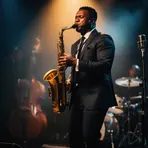
Jazz is an African American music born of resistance and struggle.
Academic text (1997) -
Spiritual involvement is found in African American music from diverse sources.
Academic text (1992) -
Rice suggests that African American music taught in colleges and universities is limited to jazz, blues, and ragtime.
Academic text (2011) -
African American music is often characterized by strong rhythms, the use of syncopated ostinati, and polyrhythms.
Academic text (1995) -
Being the purest African American music, Gullah music incorporates clapping, foot stomping, and singing.
Academic text (2011) -
By the late 1920s, there was a national market for African American music in the radio and record industries, giving ambitious musicians who wanted more than a lifetime playing rural juke joints even more reason to leave Clarksdale and the Delta behind.
Academic text (2018) -
This nonmaterial aspect of African-American music virtually assured its survival, replete with Africanisms, from Africa through the slave period to the present.
Academic text (1992) -
LeRoi Jones considered another aspect of African-American music when he wrote that "the call-and-response form of Africa (lead and chorus) has never left us as a mode of musical expression."
Academic text (1992)
Synonyms
 7
2.8
7
2.8
Music made by Black artists, like blues, jazz, gospel, and hip hop
Surface Forms
Morphology
The meaning is directly compositional: 'African-American' specifies the cultural source/identity and 'music' names the art form, so the phrase denotes music from African-American communities. This follows a common modifier+noun pattern found cross-linguistically and contains no idiomatic shift, so a B1 learner who knows both constituents will readily understand it.
Etymology
African-American music comes from the songs made by African-American communities, where people mixed African beats, church songs and work tunes into new sounds. That's why it now means 'a broad style of music' including spirituals, blues and jazz that grew from those community songs.