
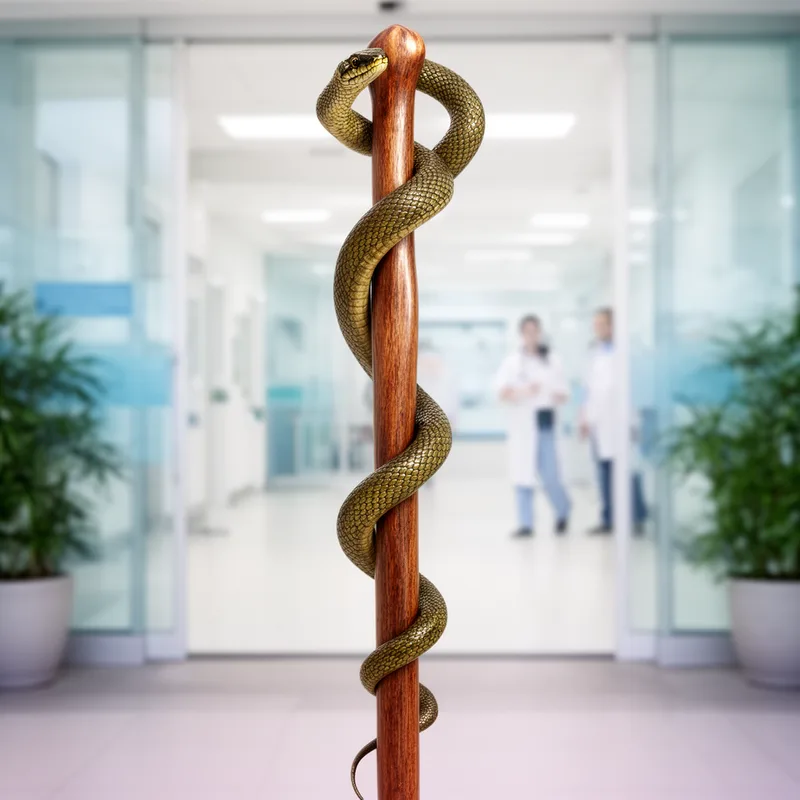
Aesculapian symbol
- noun
- /ˌɛs.kjʊˈleɪ.pi.ən ˈsɪm.bəl/
- Literature
- In ancient Greece, physicians displayed the Aesculapian symbol outside their places of healing.
Examples
-
Many people mistakenly confuse the caduceus with the Aesculapian symbol in medical contexts.
-
The Aesculapian symbol can be found on many medical association logos worldwide.
-
The Aesculapian symbol is often seen in hospitals.
-
Many medical professionals use the Aesculapian symbol in their logos.
-
In ancient Greece, physicians displayed the Aesculapian symbol outside their places of healing.
-
Many people mistakenly confuse the caduceus with the Aesculapian symbol in medical contexts.
-
The Aesculapian symbol can be found on many medical association logos worldwide.
Synonyms

 1
9.9
1
9.9

A staff with two snakes wrapped around it and wings, used as a medical symbol
Surface Forms
Morphology
The phrase is a straightforward adjective + noun composition: if a learner knows 'Aesculapian' (related to the god of medicine/healing) and 'symbol' (a sign or representation), they can infer it denotes a symbol representing healing or medicine. This follows standard compositional patterns and would be understandable to a B1 learner who knows both constituent meanings.
Etymology
The Aesculapian symbol comes from the ancient Greek god Aesculapius, who carried a staff with a snake wrapped around it as a sign of healing. Because the snake shed its skin and looked reborn, the image came to stand for 'healing' and 'medicine' today.