
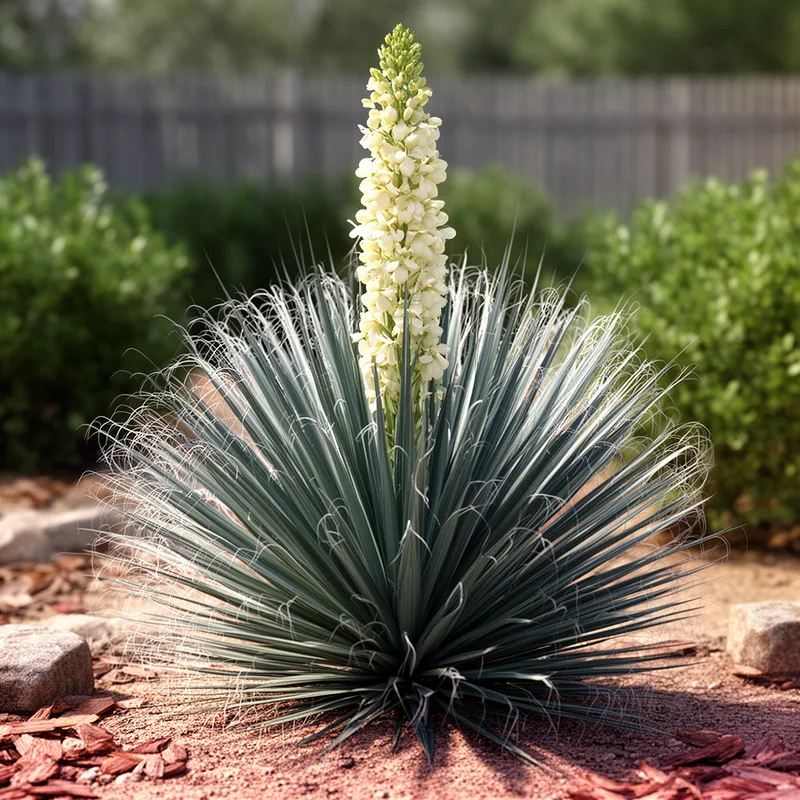
Adam's needle
 4
9.3
4
9.3

- noun
- /ˈædəmz ˈniːdəl/
- US
- Pop drained his bottle, head thrown back, Adam's apple bobbing.
Examples
-
Joel saw the Adam's apple bob in a reflexive swallowing motion.
Fiction book (2000) -
Another man was hit in his Adam's apple with a rubber bullet and had to undergo an emergency tracheotomy.
Academic text (2001) -
We see the trace of a thick, ropy scar by his Adam's apple.
Fiction book (2002) -
Her fist flashed up and smacked him in the Adam's apple.
Fiction book (1991) -
The boy's Adam's apple bobbed as he swallowed once; then he applied his stylus rapidly to the sketchboard.
Fiction book (2000) -
His collar was unbuckled and the top buttons on his jacket were undone, displaying his prominent Adam's apple.
Fiction book (2000) -
His tie was watermelon-red, tightly knotted under his Adam's apple, which flexed sprightly like a Ping-Pong ball as he spoke.
Fiction book (2000) -
In the garden, the tall Adam's needle adds a striking vertical element among the other plants.
-
The spiky leaves of Adam's needle are easy to recognize in the landscape of the desert.
-
Many gardeners appreciate Adam's needle for its unique foliage and resilience in dry conditions.
Synonyms
A tough garden plant with long stiff leaves that have white threads on the edges
A plant that grows in dry places with long stiff leaves that have thin threads along the edges

A desert plant with long stiff leaves that have thin threads at the edges
Surface Forms
Morphology
Adam's + needle
The noun 'needle' clearly signals a thin, pointed shape, so a learner who knows 'needle' can plausibly infer this refers to something needle-like (i.e., a plant with stiff, pointed leaves). However, 'Adam's' is an arbitrary eponym that does not contribute predictable semantic content about the species, so the full specific meaning (a particular yucca) is not fully derivable from the parts.
Etymology
Adam's needle may come from the plant's long, stiff leaves that look like a sharp needle, and from the thin fibers that come off the edges like a thread. Old folk names even pair it with 'Eve's thread', so the name helps us picture the plant's pointed leaves and thread-like fibers today.