
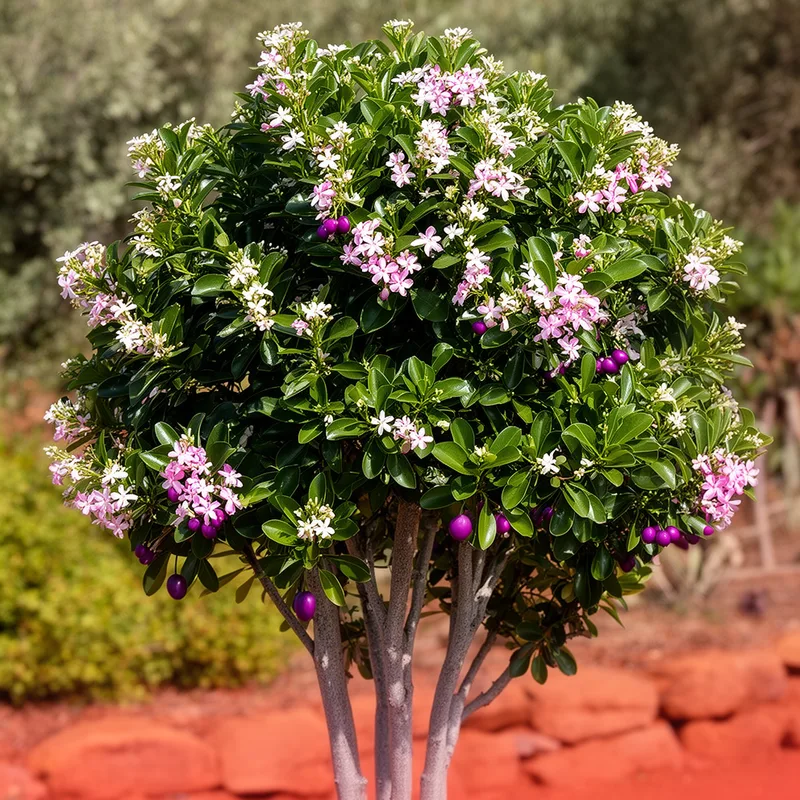
Acocanthera oblongifolia
- noun
- Specialized
- The Acocanthera oblongifolia is often grown in gardens for its attractive glossy leaves and flowers.
Examples
-
Researchers study Acocanthera oblongifolia for its medicinal properties and ecological role in South African forests.
-
Many animals avoid the berries of Acocanthera oblongifolia due to their toxicity.
-
The Acocanthera oblongifolia thrives in sunny areas.
-
I saw an Acocanthera oblongifolia in the botanical garden.
-
Many animals avoid the berries of Acocanthera oblongifolia due to their toxicity.
-
Researchers study Acocanthera oblongifolia for its medicinal properties and ecological role in South African forests.
-
The Acocanthera oblongifolia is often grown in gardens for its attractive glossy leaves and flowers.
Synonyms
A medium-sized shrubby tree from South Africa with thick evergreen leaves, white or pink flowers and round dark fruits

A medium-sized evergreen shrub or tree from South Africa with thick leaves and purplish black berries
Surface Forms
Morphology
Acocanthera + oblongifolia
This is a Latin binomial combining a genus name (Acocanthera — a type of tree/shrub) with a descriptive epithet (oblongifolia, literally ‘oblong‑leaved’), so the sense ‘a species of Acocanthera with oblong leaves’ is compositional if the learner can parse the Latin roots. However, the specific epithet is not an ordinary English word and requires botanical/Latin knowledge, so the relation is only partly transparent to an average B1 learner.
Etymology
Acocanthera oblongifolia may come from old Greek words for 'remedy' and 'thorn'; the genus name Acocanthera points to the plant's use as a strong medicine and as a poison. The Latin species name oblongifolia means 'long leaves', so the full name tells you about both its traditional use and its long, thick leaves.

