
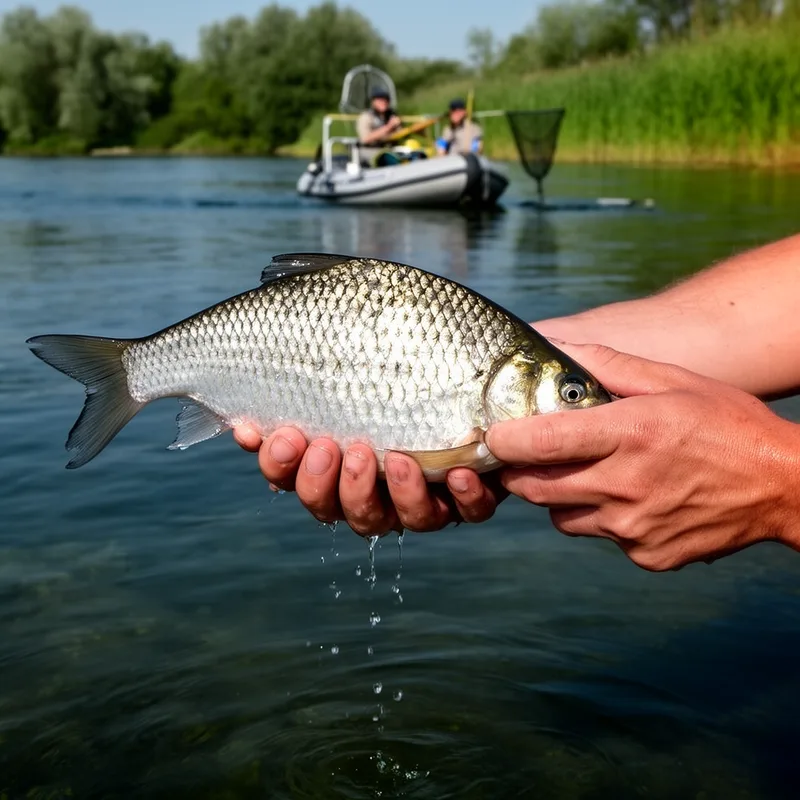
Abramis brama
- noun
- UK
- The common bream, known scientifically as Abramis brama, swims gracefully in the clear waters of the lake.
Examples
-
The Abramis brama is often found in lakes and rivers across Europe.
-
Many anglers catch Abramis brama for sport rather than for food.
-
Anglers often catch Abramis brama, although it is not highly prized for eating.
-
Biologists conducted a survey of Abramis brama populations in the lake.
-
The river was filled with Abramis brama, shimmering in the afternoon sun.
-
Many fishermen target Abramis brama, enjoying the challenge of catching this freshwater fish.
-
Researchers studied the habitat of Abramis brama to understand its role in the freshwater ecosystem.
Synonyms

 2
6.0
2
6.0

A fish with a flat, deep body that lives in fresh or salt water

A freshwater fish with a flat body and silver scales that is not often eaten
Surface Forms
Morphology
Abramis + brama
This is a Latin binomial rather than a compositional English phrase: knowing 'Abramis' (a fish genus) lets a learner infer the term refers to a species of fish, but the specific sense 'brama' (the common bream) is not transparently derivable from the parts and 'brama' is not an English lexical item. Because the genus label gives partial information (it signals a fish species) but does not yield the full, specific meaning, the expression is only partially predictable to learners.
Etymology
Abramis brama takes its name from the old word 'bream', a flat, silvery freshwater fish found in rivers and lakes. The repeating parts Abramis and brama link the Latin name to that common fish, so the name simply points to the common bream.