
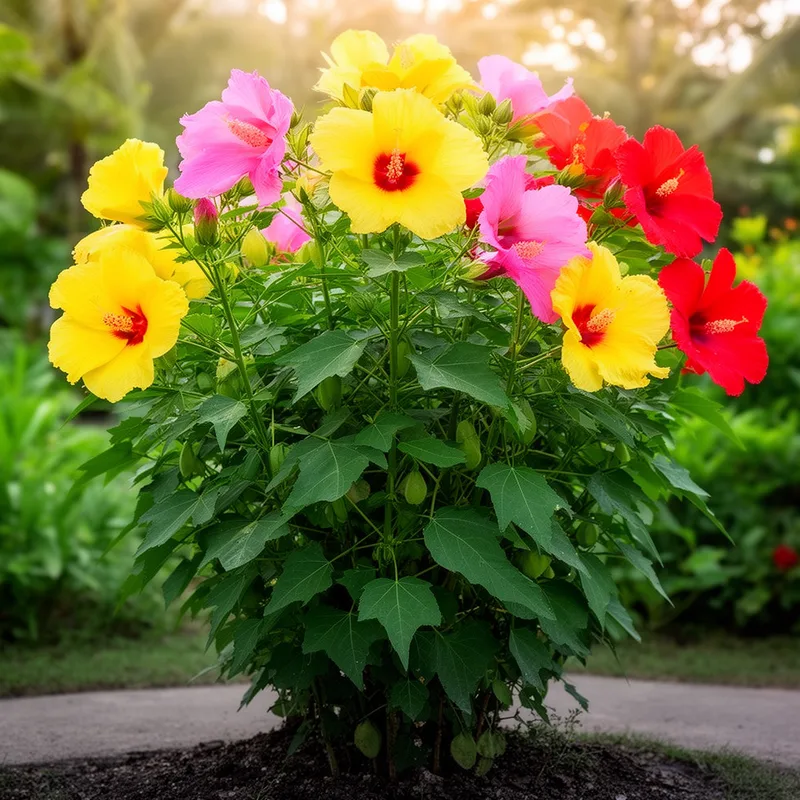
Abelmoschus moschatus
- noun
- Specialized
 :
Abelmoschus moschatus
:
Abelmoschus moschatus
- The seeds of Abelmoschus moschatus are sometimes used in perfumery for their musky aroma.
Examples
-
Botanists collected several specimens of Abelmoschus moschatus during their expedition in Southeast Asia.
-
Many gardeners love to cultivate Abelmoschus moschatus in their backyards.
-
Abelmoschus moschatus is prized in gardens for its strikingly colorful flowers.
-
The Abelmoschus moschatus plant is known for its vibrant flowers.
-
Abelmoschus moschatus is known for its vibrant yellow, pink, or scarlet flowers, adding beauty to tropical gardens.
-
Gardeners often choose Abelmoschus moschatus for its striking hibiscus-like blooms that attract butterflies.
-
Abelmoschus moschatus thrives in warm climates and is valued for its colorful floral display in landscapes.
Synonyms

A bushy tropical plant from Asia with bright cup-shaped flowers in yellow, pink, or scarlet

A bushy tropical plant with flowers like a hibiscus in yellow, pink, or red
A bushy tropical plant with flowers like hibiscus that are yellow, pink, or scarlet
Surface Forms
Morphology
Abelmoschus + moschatus
This is a Latin binomial (scientific name) rather than a compositional English phrase; the second element 'moschatus' is a Latin epithet (not a standard English word) and the name functions as a proper noun referring to a specific species. Even if a learner recognized 'Abelmoschus' as a plant genus, they would not be able to derive the specific descriptive meaning (bushy herb with hibiscus-like flowers) from the parts, so it is not predictable for a B1 learner.
Etymology
Abelmoschus moschatus may come from old words for 'musk', because the plant's seeds have a strong musk smell. The first part, Abelmoschus, and the second part, moschatus, both point to that 'musk' scent, which explains why people grow the plant for its flowers and use its seeds in perfume.

