
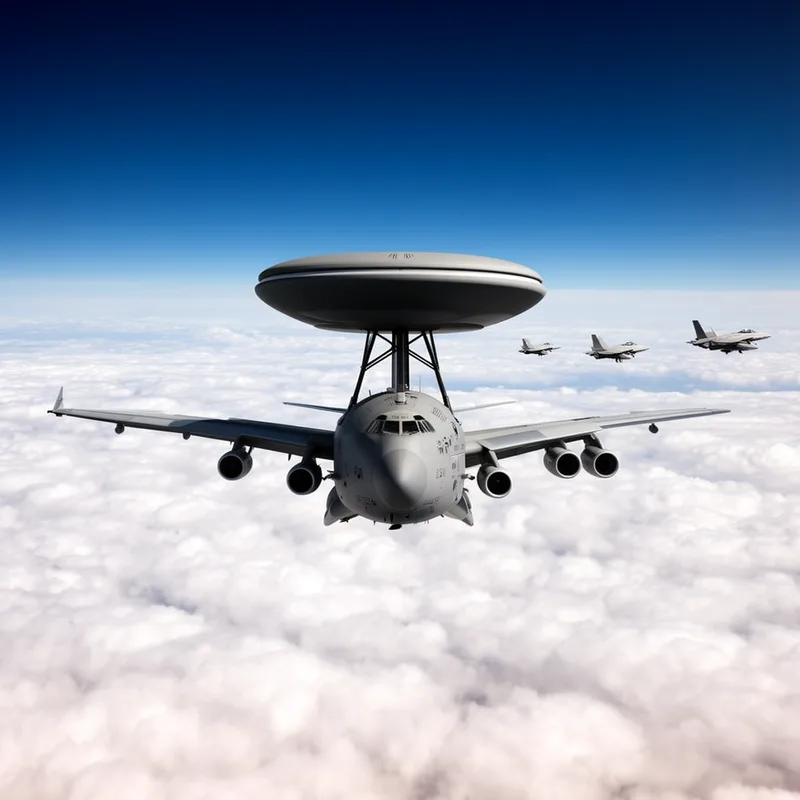
AWACS
 11
8.4

- noun
- /ˈeɪˌwæks/
- Specialized
- While monitoring the battlefield, the AWACS provided crucial information to ground and air units.
- AWACS early-warning system
- AWACS-type aircraft
Examples
-
The AWACS can effectively manage airspace by coordinating the movements of various aircraft.
-
Then AWACS will call in support.
-
Air Force One and Liberty 24, this is AWACS Blue Star.
-
High over the northern Gulf, an American AWACS plane noted the explosion on one of its heat sensors.
Fiction book (1994) -
Among the airplanes, chief was the Airborne Warning and Control System, known as AWACS.
Fiction book (1994) -
After the Iraqi Air Force gave up combat operations, AWACS served exclusively as an airborne air traffic controller for the 2,000 to 3,000 sorties a day.
Academic text (1991) -
Two systems, both manned airborne radars, illustrate the new capability: AWACS (Airborne Warning and Control System) and JSTARS (Joint Surveillance and Targeting Radar System).
Academic text (1991) -
The military deployed an AWACS to ensure no unauthorized planes entered the designated airspace.
Surface Forms
Etymology
AWACS comes from the phrase Airborne Warning and Control System, where Airborne means 'flying', Warning means 'alert', and Control means 'directing'. Think of an AWACS as a big 'radar' plane or an 'eye in the sky' that watches and directs other aircraft, which is why it monitors and manages airspace.